Replies
Welcome, guest
Join CrazyEngineers to reply, ask questions, and participate in conversations.
CrazyEngineers powered by Jatra Community Platform
-
@neeraj-iAaNcG • Jun 12, 2012
aarthivgwhat is the function of 'main' in 'c' programming?
int main (void)
In the above statement, void represent??void represents that main function is not taking any argument while its execution. You can even skip that void and write main(). main takes two arguments like main(int argc, char *argv[])
where argc is the counter that counts the number of arguments passed to main and argv means argument vector which stores all the arguments passed in the form of a character array -
@aarthivg-HH344f • Jun 12, 2012
I remember using as such: void main()
whats the difference between these statement.
void main()
int main(void) -
@aarthivg-HH344f • Jun 12, 2012
Nick_Sharmavoid represents that main function is not taking any argument while its execution. You can even skip that void and write main(). main takes two arguments like main(int argc, char *argv[])
where argc is the counter that counts the number of arguments passed to main and argv means argument vector which stores all the arguments passed in the form of a character arrayIs arguments and parameter, both mean the same
-
@anoop-kumar-GDGRCn • Jun 12, 2012
void main() means... this function is not returning any value.
int void main() is a illegal declaration .
either it could be int main() , which must have a integer type return statement as last line of function
or another type of return. -
@aarthivg-HH344f • Jun 12, 2012
ianoopvoid main() means... this function is not returning any value.
int void main() is a illegal declaration .
either it could be int main() , which must have a integer type return statement as last line of function
or another type of return.sorry, its int main(void)
-
@anoop-kumar-GDGRCn • Jun 12, 2012
aarthivgsorry, its int main(void)
that means main function is not taking any argument and will return a integer type value.
why should not you make some programs about your doubts.compiler itself will tell you . -
@aarthivg-HH344f • Jun 12, 2012
ianoopthat means main function is not taking any argument and will return a integer type value.
why should not you make some programs about your doubts.compiler itself will tell you .ya I have too. I don't have the software๐
-
@neeraj-iAaNcG • Jun 12, 2012
-
@dancer-engineer-EJ8rGI • Jun 13, 2012
-
@silverscorpion-iJKtdQ • Jun 13, 2012
The function definition in C is like this..
<return-type> function-name(<list-of-arguments>)
Here, return-type can be of any data-type, like int or char etc.. It can also be "void" which means that function doesn't return anything.
In the list of arguments, you can give one or more arguments (or) 'parameters' to the function. If the function doesn't take any arguments, you can specify that by writing 'void' in place of the arguments. Hence 'function-name(void)'. But usually, if a function doesn't take any arguments, it's name is simply followed by a set of parentheses, like so.. "function-name()" -
@aarthivg-HH344f • Jun 13, 2012
return statement means?
-
@neeraj-iAaNcG • Jun 13, 2012
aarthivgreturn statement means?
return type depicts the type of value that your function returns. return statement returns a value to the caller function. Consider following program
main() { int c; c=sum(); printf("%d",c); return 0; } int sum() { int a=1,b=2; return(a+b); }In the above program, return(a+b) is called return statement as it returns an integer value to the calling function that is main. Now as an integer value is returned, there must be a variable to hold the returned data and even that must be of the same type as the type of value returned i.e. int in this case..
-
@herrey-bokSq9 • Jun 13, 2012
Well how differ main from array?
I know in C++ array are so important so can you explain its difference? -
@neeraj-iAaNcG • Jun 13, 2012
herreyWell how differ main from array?
I know in C++ array are so important so can you explain its difference?There is no match between main and array. They are two different things all together. main() marks the beginning point of execution of a program whereas array is simply a collection of objects of same type which are referred under a same name whose memory is allocated statically. main() is a function whereas array is a collection of elements of the same data type
-
@aarthivg-HH344f • Jun 13, 2012
Nick_Sharmareturn type depicts the type of value that your function returns. return statement returns a value to the caller function. Consider following program
main() { int c; c=sum(); printf("%d",c); return 0; } int sum() { int a=1,b=2; return(a+b); }In the above program, return(a+b) is called return statement as it returns an integer value to the calling function that is main. Now as an integer value is returned, there must be a variable to hold the returned data and even that must be of the same type as the type of value returned i.e. int in this case..return 0 implies ?
-
@neeraj-iAaNcG • Jun 13, 2012
As I have not specified any return type for main, by default it will be int. So as the system calls the main function, you are just returning a dummy integer value. It doesn't do anything..
-
@aarthivg-HH344f • Jun 13, 2012
then getch() is used for?
-
@neeraj-iAaNcG • Jun 14, 2012
-
@aarthivg-HH344f • Jun 14, 2012
#include<stdio.h>
#include<stdlib.h>
int main()
{
int a,b,sub;
printf(" enter the value of a");
scanf("%d",&a);
printf("enter the value of b");
scanf("%d",&b);
sub=a-b;
printf(" %d",&sub);
return 0;
}
just tried out a simple program.... but cant able to get the output... whats wrong in it
for 3-2 ... getting output as 9016 -
@neeraj-iAaNcG • Jun 14, 2012
aarthivgprintf(" %d",&sub);
Here is the mistake. & is called address operator. So when you are printing &sub, you are printing the address at which the result is stored and not the result. replace the above line with
printf("%d",sub);
This will make your program work perfectly.. -
@aarthivg-HH344f • Jun 14, 2012
Nick_SharmaHere is the mistake. & is called address operator. So when you are printing &sub, you are printing the address at which the result is stored and not the result. replace the above line with
printf("%d",sub);
This will make your program work perfectly..ya...thanks... got it
-
@aarthivg-HH344f • Jun 14, 2012
what is the use of SYSTEM("PAUSE") command
-
@neeraj-iAaNcG • Jun 14, 2012
aarthivgwhat is the use of SYSTEM("PAUSE") command
System() is used to call OS functions. System("pause") causes the DOS output screen to be held. It does the same function as getch() when used as the last line in program. If you don't write getch() or System("pause") in the earlier versions of C then the black screen just flashes and then disappears. Then you must press alt+f5 to view the output. System("pause") and getch() prevents the flashing of screen and holds it till a character is entered
-
@aarthivg-HH344f • Jun 14, 2012
Is there a header file defined Boolean constant as stdbool.h?
#include<stdio.h>
#include<stdbool.h>
int main(void)
{
bool x=true;
bool y=false;
printf(" the boolean values are %d %d\n",x,y);
return 0;
} -
@aarthivg-HH344f • Jun 17, 2012
Is there a header file defined Boolean constant as stdbool.h?
#include<stdio.h>
#include<stdbool.h>
int main(void)
{
bool x=true;
bool y=false;
printf(" the boolean values are %d %d\n",x,y);
return 0;
}
help me out
Tagging #-Link-Snipped-# #-Link-Snipped-# #-Link-Snipped-# -
@anoop-kumar-GDGRCn • Jun 17, 2012
I have no idea about it... ๐
-
@neeraj-iAaNcG • Jun 18, 2012
Same here. No idea. Tried searching it but with no significant answer.. Anyway the above program is not working in Turbo C++ 4.5. I downloaded stdbool.h and tried but then also there are errors...
-
@abhishek-fg9tRh • Feb 16, 2013
Sorry for bumping in old thread (Killing time);
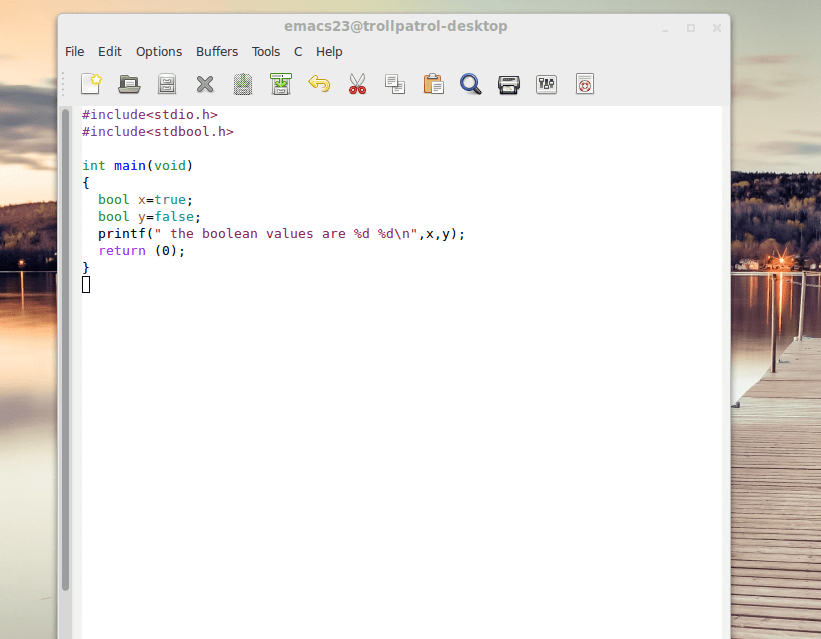
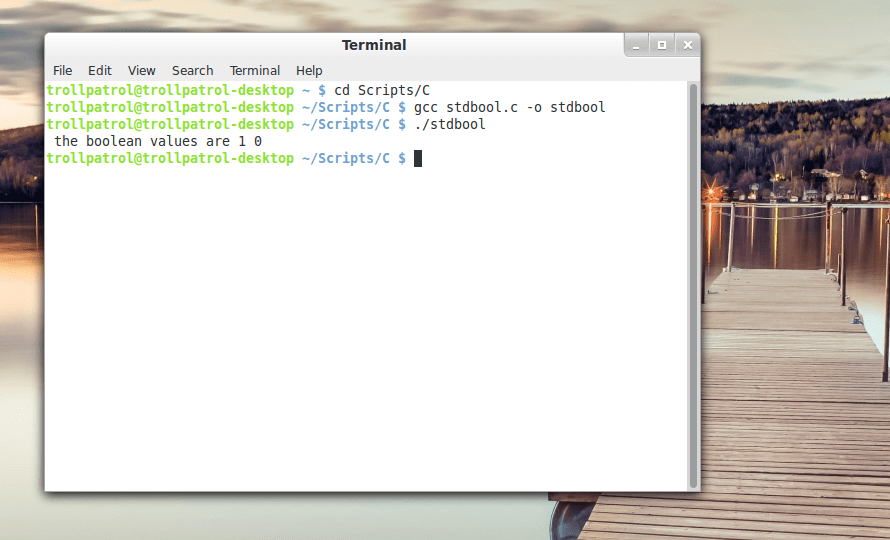
Yes, there's a header file defined boolean constant as stdbool.h

Using emacs editor & GCC 4.7 -
@sulochana-anand-OrGmKr • Mar 4, 2013
the execution of program starts from main function.
-
@bithamang-9pwN1D • Mar 14, 2013
in 11th line u should write as
printf("%d",sub);
only u put & before sub so it displays the address of sub -
@sanyam-Nl7Zqc • Apr 4, 2013
aarthivgwhat is the function of 'main' in 'c' programming?
int main (void)
In the above statement, void represent??
The main function has two basic functions :-
1) It allocates the memory for program.
2) It guides the compiler, that compilation will start from the main function.
In the statement
int main (void); (always terminate a statement with a semicolon) ๐
void represents that the function do not takes any arguments.
The statement is same as
int main(); ๐
If you still have any doubts, feel free to ask ๐ -
@rahul69-97fAOs • Apr 4, 2013
Sanyam Khuranaint main (void); (always terminate a statement with a semicolon) ๐
Not always!!๐ Actually avoid semicolon in case of loops and conditional statements(ie if blocks)
eg:int i=0; while (i<10); i++;
. Big Blunder!!๐๐
-
@lit-857-hXUEGJ • Apr 4, 2013
int main() return value to whom??
-
@lit-857-hXUEGJ • Apr 4, 2013
last line should be printf("%d",sub);
-
@lit-857-hXUEGJ • Apr 4, 2013
aarthivg#include<stdio.h>
#include<stdlib.h>
int main()
{
int a,b,sub;
printf(" enter the value of a");
scanf("%d",&a);
printf("enter the value of b");
scanf("%d",&b);
sub=a-b;
printf(" %d",&sub); //error//
return 0;
}
just tried out a simple program.... but cant able to get the output... whats wrong in it
for 3-2 ... getting output as 9016
line should be printf("%d",sub); -
@avii-TGGs8o • Apr 4, 2013
-
@sanyam-Nl7Zqc • Apr 5, 2013
rahul69Not always!!๐ Actually avoid semicolon in case of loops and conditional statements(ie if blocks)
eg:int i=0; while (i<10); i++;
. Big Blunder!!๐๐haha, yes that's true, I was talking about General statements ๐
-
@lit-857-hXUEGJ • Apr 5, 2013
who call the main function
-
@sanyam-Nl7Zqc • Apr 6, 2013
-
@vishal-pysGmK • Apr 6, 2013
ianoopvoid main() means... this function is not returning any value.
int void main() is a illegal declaration .
either it could be int main() , which must have a integer type return statement as last line of function
or another type of return.
actually it returns a value.. but its not specific so we call it void.. -
@vishal-pysGmK • Apr 6, 2013
lit-857who call the main function
its the operating system...
and main() is always "public" so that it is visible to the OS -
@abhishek-fg9tRh • Apr 6, 2013
Vishal0203its the operating system...
and main() is always "public" so that it is visible to the OSAs per my knowledge, RTE calls the main function & not just OS.
-
@lit-857-hXUEGJ • Apr 6, 2013
wts RTE and main () return value to whome???
-
@vishal-pysGmK • Apr 6, 2013
RTE stands for run-time environment..
main() returns value to RTE itself, indicating its status of execution -
@lit-857-hXUEGJ • Apr 6, 2013
plz explain it i can't understend
-
@vishal-pysGmK • Apr 7, 2013
Means, if main returns a null value, then the program is executed successfully.. 0 indicates EXIT_ON_SUCCESS
any value other than zero indicates unusual execution.. -
@anand-tamariya-DnfjEX • Apr 7, 2013
lit-857plz explain it i can't understend
A c program is compiled into assembly code(and finally into binary). The main() function enables the compiler to put the code present in this method as first line in the compiled version - the entry point of the program when you execute it.
-
@vishal-pysGmK • Apr 7, 2013
main is a function and array is a collection of elements of same data type defined under same name..
no point of getting confused here. -
@lit-857-hXUEGJ • Apr 11, 2013
wts d/f b/w celloc() and melloc() fn
-
@vishal-pysGmK • Apr 11, 2013
lit-857wts d/f b/w celloc() and melloc() fn
ummm... do you have a text Book to learn C??
I think you must refer that.. text books are the first companions. after reading that, still you face problems in understanding, we'll help you