

Cheap Water Purification System Uses Sapwood, Filters 99% Bacteria - MIT Researchers

Making it possible for people in unprivileged areas with rural communities to have a cheap, low-tech water filtration solution, a team of researchers from MIT have developed a filtration system that uses a small bark of sapwood inserted in a plastic tube, to remove 99% of the bacteria E. coli from water. The system is capable of producing 4 litres of drinking water every day. The simplicity of the new technique relies on the size of the pores in sapwood. Every pore contains a xylem tissue evolved to transport sap up the length of a tree. By running water through these pores, this tissue blocks most types of bacteria. A research paper describing these findings has been submitted in PLOS One by Rohit Karnik, an associate professor of mechanical engineering, Michael Boutilier and Jongho Lee from MIT, Valerie Chambers from Fletcher-Maynard Academy in Cambridge, Mass., and Varsha Venkatesh from Jericho High School in Jericho, N.Y.
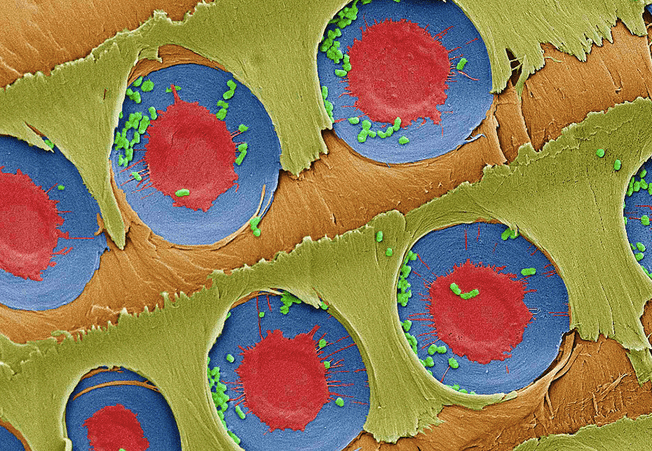
A false-color electron microscope image that shows the E. coli bacteria (green) trapped over xylem pit membranes (red and blue) in the sapwood after filtration.
The existing filtration systems involve the use of chlorine treatment which is expensive. Other low-cost methods like boiling of water requires the ever-depleting fuels, whereas the membrane-based filters require a pump and can become easily clogged. Therefore, Sapwood comes in the picture as a small-scale, cheap alternative. The researchers carried out experiments on the sapwood use, and figured out that there are certain limitations to the size of particles that can be filtered depending on the type of sapwood chosen. The filter probably cannot trap most viruses, which are much smaller in size than 200 nanometers.
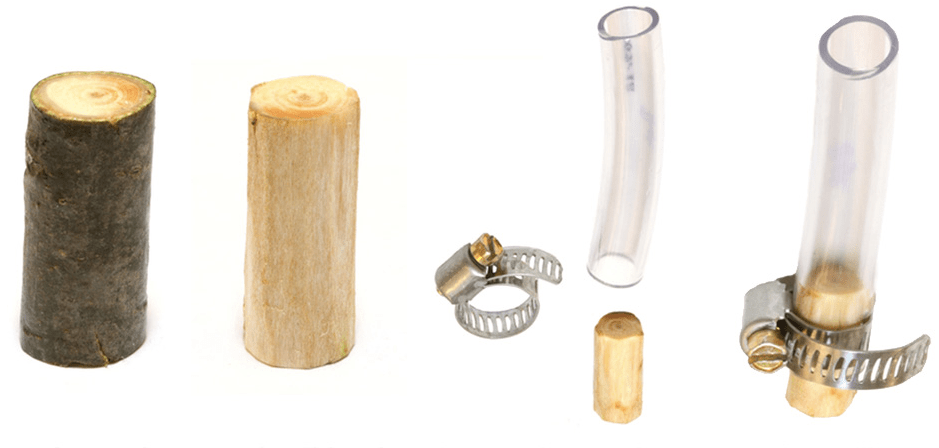
Image: Simple filter uses peeled bark of white pine inserted in a plastic tube
Though the new Sapwood method is really useful in the parts of the world where people collect surface water, which can be polluted with particles of decaying plant and animal matter as well as fine dust. The group's design is very effective in filtering out most of the dangerous bacteria. The team is now working on evaluating the filtering potential of other types of sapwood. The great thing about the use of this naturally occurring material is that the thin slice of wood can be thrown away and replaced at almost no cost.
That's some good research work that the MIT team has come up with. What are some other cheap water filtration alternatives available today? Share with us in comments below.
Source: #-Link-Snipped-#