
India To House The World's 3rd LIGO To Detect Elusive Gravitational Waves
Following the breakthrough discovery of Gravitational Waves by two American detectors, exactly hundred years after they were predicted by Albert Einstein, astrophysicist Srinivas R Kulkarni from the California Institute of Technology (Caltech), USA and Karan Pankaj Jani have successfully persuaded the Indian Prime minister Narendra Modi to set up the third LIGO detection centre in India in the near future.
During the early morning of 11th February, the Laser Interferometer Gravitational Wave Observatory announced the much awaited discovery of Gravitational Waves originating from a cataclysmic event in the distant universe, and thereby strengthened the foundation of Einstein’s revolutionary theory of General Relativity. Although the Raman Research Institute in Bengaluru had initially decided to implement the project of building a GW detector, a variety of reasons including lack of motivation, slow progress and a comparatively small budget allocation had caused an untimely abandonment of the LIGO-India proposal of 2011.
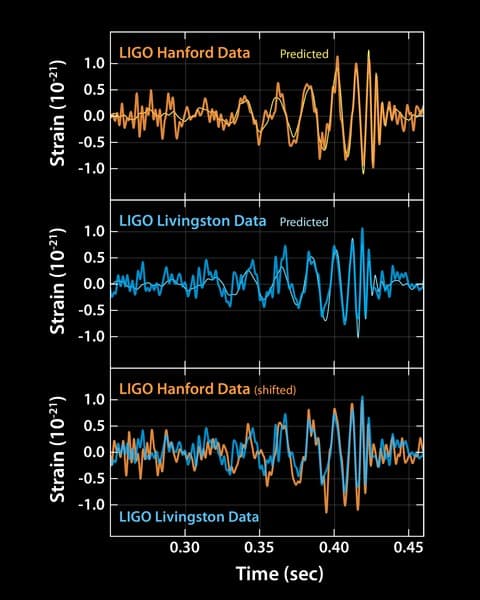
Gravitational wave as predicted by Einstein
The Indlgo project includes the proposed idea of building an advanced gravitational-wave observatory in India as a part of a worldwide network and collaboration among the US National Science Foundation, the Institute of Plasma Research (IPR) Gandhinagar, the Inter University Centre for Astronomy and Astrophysics (IUCAA), Pune and the Raja Ramanna Centre for Advanced Technology (RRCAT), Indore.
The suggested LIGO India proposal reveals that the detector will be a Michelson Interferometer with Fabry-Perot enhanced L-shaped arms having 4km length and would be designed to detect minute changes from 10-23 Hz-1/2 in the frequency range between 30 to 800 Hz. The site and location of this mega scientific venture has not yet been confirmed although Rajasthan and Maharashtra possess potential vacant areas.
Insiders revealed that the Indian Government is likely to invest Rs 1000 crore for the Indian LIGO project over the next 15 years. Experts also asserted that with the initialization of this project, India would create a new legacy in the field of science and technology and re-establish India’s scientific prowess.
Watch gravitational wave chirp: Sound of the collision of celestial giants
Source: #-Link-Snipped-# | LIGO-M1100296-v2: LIGO-India, Proposal of the Consortium for Indian Initiative in Gravitational-wave Observations (IndIGO),[Public]
During the early morning of 11th February, the Laser Interferometer Gravitational Wave Observatory announced the much awaited discovery of Gravitational Waves originating from a cataclysmic event in the distant universe, and thereby strengthened the foundation of Einstein’s revolutionary theory of General Relativity. Although the Raman Research Institute in Bengaluru had initially decided to implement the project of building a GW detector, a variety of reasons including lack of motivation, slow progress and a comparatively small budget allocation had caused an untimely abandonment of the LIGO-India proposal of 2011.
Gravitational wave as predicted by Einstein
The suggested LIGO India proposal reveals that the detector will be a Michelson Interferometer with Fabry-Perot enhanced L-shaped arms having 4km length and would be designed to detect minute changes from 10-23 Hz-1/2 in the frequency range between 30 to 800 Hz. The site and location of this mega scientific venture has not yet been confirmed although Rajasthan and Maharashtra possess potential vacant areas.
Insiders revealed that the Indian Government is likely to invest Rs 1000 crore for the Indian LIGO project over the next 15 years. Experts also asserted that with the initialization of this project, India would create a new legacy in the field of science and technology and re-establish India’s scientific prowess.
Watch gravitational wave chirp: Sound of the collision of celestial giants
Source: #-Link-Snipped-# | LIGO-M1100296-v2: LIGO-India, Proposal of the Consortium for Indian Initiative in Gravitational-wave Observations (IndIGO),[Public]
Replies
You are reading an archived discussion.
Related Posts
If you purchased your MacBook after June 2015, it is possible that you might be eligible for a free of charge replacement of the USB-C cable that you received with...
A research team from the Joint Quantum Institute have developed a way for qubits to interact with photons, which could ultimately lead to futuristic quantum networks. Theorists explained that such...
National Programme on Technology Enhanced Learning .It is a project founded by ministery of human resource development provides e-learning on various courses such as engineering ,science etc .It is a...
Lenovo is all set to launch the global variant of its locally successful handset, the Lenovo Lemon 3 at the upcoming Mobile World Congress that is scheduled to be held...
While other smartphone manufacturers wait until the Mobile World Congress to launch their new devices, Microsoft has jumped the gun and unveiled its first mid-range Windows 10 Mobile offering, the...