Google Valentine Day Easter Egg: Algebraic Equation!

If you want to impress your friends with your Google search abilities; enter the following search query in Google search bar and hit enter.

sqrt(cos(x))*cos(300x)+sqrt(abs(x))-0.7)*(4-x*x)^0.01, sqrt(6-x^2), -sqrt(6-x^2) from -4.5 to 4.5

โ˜• What gives?

Replies

Welcome, guest

Join CrazyEngineers to reply, ask questions, and participate in conversations.

CrazyEngineers powered by Jatra Community Platform

  • Dancer_Engineer

    @dancer-engineer-EJ8rGI • Feb 9, 2012

    Valentine Day does not exist for year 2012!

    Want proof?

    Here: 14-02-12 = 0

    ๐Ÿ˜

  • Anoop Kumar

    @anoop-kumar-GDGRCn • Feb 9, 2012

    This one looks better:
    Copy n paste in google

     
    sqrt(cos(x))*cos(180x)+sqrt(abs(x))-0.7)*(4-x*x)^0.01, sqrt(6-x^2), -sqrt(6-x^2) from -4 to 4


    hit enter

  • Anoop Kumar

    @anoop-kumar-GDGRCn • Feb 9, 2012

    The_Big_KIf you want to impress your friends with your Google search abilities; enter the following search query in Google search bar and hit enter.

    sqrt(cos(x))*cos(300x)+sqrt(abs(x))-0.7)*(4-x*x)^0.01, sqrt(6-x^2), -sqrt(6-x^2) from -4.5 to 4.5
    โ˜• What gives?

    There is warning in your code: The function might not be plotted correctly. ๐Ÿ˜›๐Ÿ˜

  • Kaustubh Katdare

    @thebigk • Feb 9, 2012

    ianoopThere is warning in your code: The function might not be plotted correctly. ๐Ÿ˜›๐Ÿ˜

    Looks like you didn't copy the complete code (there's a horizontal scrollbar). Or maybe Google doesn't heart you? ๐Ÿ˜’

    Kidding!

  • PraveenKumar Purushothaman

    @praveenkumar-66Ze92 • Feb 9, 2012

    ianoopThis one looks better:
    Copy n paste in google

     
    sqrt(cos(x))*cos(180x)+sqrt(abs(x))-0.7)*(4-x*x)^0.01, sqrt(6-x^2), -sqrt(6-x^2) from -4 to 4
     
    
    hit enter

    This is kinda corrugated! Biggie's one was the BEST! ๐Ÿ˜›

  • circularsquare

    @circularsquare-CAswn0 • Feb 9, 2012

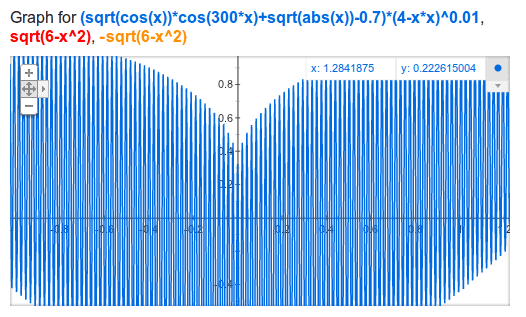
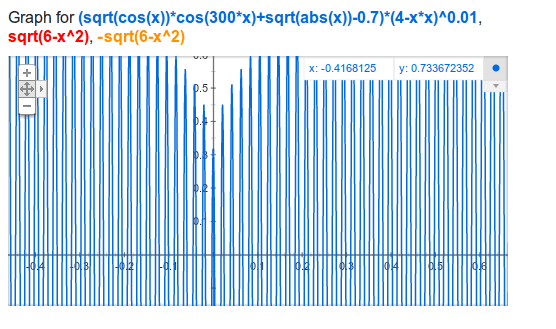
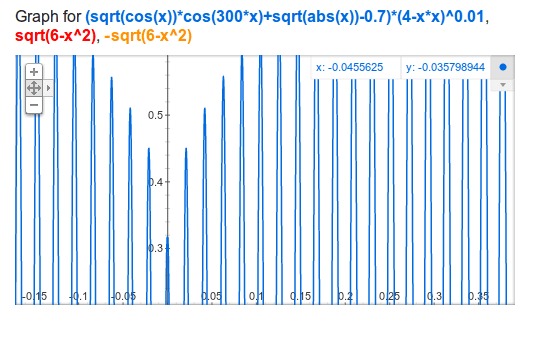
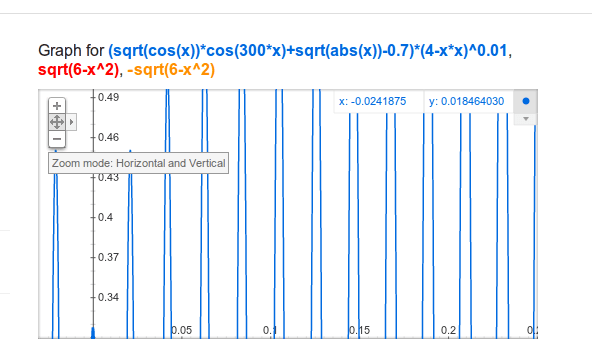
    When I saw it at first I wracked my brains over how the plot is 'shaded'. Because by definition a function is such that for a particular value of x , there is only one value of y.

    But I noticed that the image is a very zoomed out version of the plot. If you zoom in it has got closely spaced sine-like curve. The zoomed-out version of the plot & the closely-spaced zero crossings give an impression of 'shaded' region. So it is indeed a function with each value of x having at most one value of y.

    Nice job.


    2012-02-10-142710_1366x768_scrot2012-02-10-142719_1366x768_scrot2012-02-10-142725_1366x768_scrot2012-02-10-142730_1366x768_scrot