

UC Berkeley Unveils World's First 3D Printed Cement Structure

@dhananjay-0OEUGZ
•
Oct 26, 2024
Oct 26, 2024
1.3K
A research team working on a ground-breaking project at University of California Berkeley has successfully developed “Bloomâ€, first ever 3D printed cement structure. The innovative structure was unveiled by Ronald Rael, associate professor of Architecture at UC Berkeley on March 6. This is the world’s first powder-based 3D printed structure developed using Portland cement and can also be de-assembled just in case of space-constraint. The team that worked on this year-long project includes Kent Wilson, Alex Schofield, Sofia Anastassiou and Yina Dong, all four graduate students from College of Environmental Design.
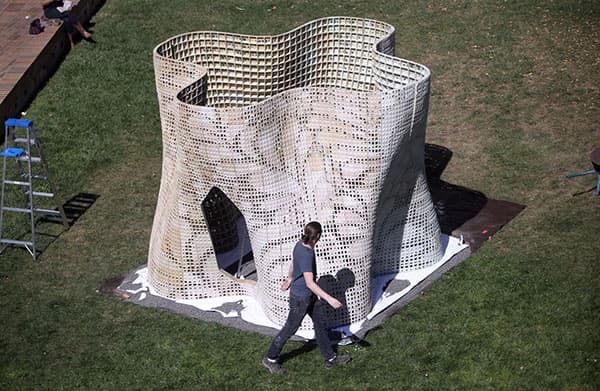
Bloom, a freestanding structure extends as high as 9 feet and has base dimensions of about 12 feet by 12 feet. The entire structure is built by assembling 840 3D blocks manufactured by Iron Oxide-free Portland cement. Reportedly, the recently developed structure overcomes several limitations of 3D printed architecture like cost and speed of production, aesthetics and practical applications. The project was carried out in collaboration with Siam Cement Group (SCG) from Thailand that provided needed cement and other materials were supplied by a startup company- Emerging Objects and Entropy Resins.
Bloom is fabricated using 11 3D printers and each enumerated brick is unique. Each block has a pattern for light to pass through. Assembling all the bricks makes up a tall decorative cement structure. In order to develop desired light-weight yet strong structure, materials like polymer and fiber are mixed with cement.
Talking about Bloom, Rael said that very few researchers are experimenting with 3D printed structures built using cement or similar materials. The project is genesis of realistic, marketable process that can transform the way we think about building a structure.
Bloom would be dis-assembled and shipped to SCG, Thailand where it will showcased for display and will also travel various locations around the world.
Have a look at how Bloom is built-
Source: #-Link-Snipped-#
Bloom, a freestanding structure extends as high as 9 feet and has base dimensions of about 12 feet by 12 feet. The entire structure is built by assembling 840 3D blocks manufactured by Iron Oxide-free Portland cement. Reportedly, the recently developed structure overcomes several limitations of 3D printed architecture like cost and speed of production, aesthetics and practical applications. The project was carried out in collaboration with Siam Cement Group (SCG) from Thailand that provided needed cement and other materials were supplied by a startup company- Emerging Objects and Entropy Resins.
Bloom is fabricated using 11 3D printers and each enumerated brick is unique. Each block has a pattern for light to pass through. Assembling all the bricks makes up a tall decorative cement structure. In order to develop desired light-weight yet strong structure, materials like polymer and fiber are mixed with cement.
Talking about Bloom, Rael said that very few researchers are experimenting with 3D printed structures built using cement or similar materials. The project is genesis of realistic, marketable process that can transform the way we think about building a structure.
Bloom would be dis-assembled and shipped to SCG, Thailand where it will showcased for display and will also travel various locations around the world.
Have a look at how Bloom is built-
Source: #-Link-Snipped-#