
NASA Reveals Submarine Design That Could Explore Titan’s Sea At NIAC

@sharvari-panchbhai-JOvYc6
•
Oct 26, 2024
Oct 26, 2024
1.9K
Last year, NASA had announced its proposal to develop a conceptual design of a possible submersible autonomous vehicle (submarine) for performing autonomous detailed scientific investigations of the liquid methane/ethane seas on Saturn's biggest moon called Titan. To address this objective, the agency has revealed a video and some details about the design at this year's NASA Innovative Advanced Concepts (NIAC) Symposium. NASA Glenn's COMPASS Team and researchers from Applied Research Lab developed this video and a sub design known as Titan Submarine Phase I Conceptual Design that could explore Titan’s largest northern sea, Kraken Mare.
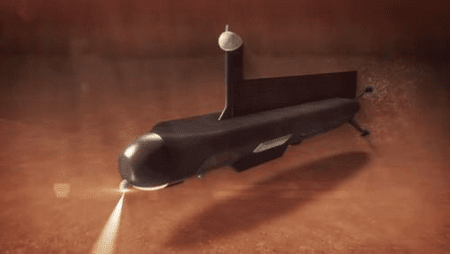
The submersible robot will have to face very hostile and distant environment of the moon. NASA has envisioned to deploy an unmanned 90-day mission mainly because it wants to find whether life existed there in the past. It also wants to find out clues on how life on Earth began as Titan is a natural satellite with thick atmosphere and the only object in our solar system other than Earth with stable bodies of surface liquid. The Kraken Mare sea covers approximately 154,000 square miles and is 525 feet deep. The submarine will have to face the strong waves of the sea and its extreme cold temperature. To address the temperature issue, the team has to develop a special piston driven type of system for preventing freezing of ballast. In addition to this, communication will also be a problem for the sub because it will have to spend most of its time in the regions where sun can’t reach. To meet this challenge the researchers envisage a system where the sub will surface for 16 hours at a time and then send signals directly to Earth by using energy source that can convert radioactive pellets into electricity.
It is expected that this sort of submarine would be ready for deployment by 2040. The mission will be the first of its kind by NASA as it will not conduct on dry land. NASA intends to build a winged craft that would sink in the Kraken Mare after making its way to the surface of the sea. Later, the sub would explore the depths of the sea.
Source: #-Link-Snipped-#via #-Link-Snipped-#
The submersible robot will have to face very hostile and distant environment of the moon. NASA has envisioned to deploy an unmanned 90-day mission mainly because it wants to find whether life existed there in the past. It also wants to find out clues on how life on Earth began as Titan is a natural satellite with thick atmosphere and the only object in our solar system other than Earth with stable bodies of surface liquid. The Kraken Mare sea covers approximately 154,000 square miles and is 525 feet deep. The submarine will have to face the strong waves of the sea and its extreme cold temperature. To address the temperature issue, the team has to develop a special piston driven type of system for preventing freezing of ballast. In addition to this, communication will also be a problem for the sub because it will have to spend most of its time in the regions where sun can’t reach. To meet this challenge the researchers envisage a system where the sub will surface for 16 hours at a time and then send signals directly to Earth by using energy source that can convert radioactive pellets into electricity.
It is expected that this sort of submarine would be ready for deployment by 2040. The mission will be the first of its kind by NASA as it will not conduct on dry land. NASA intends to build a winged craft that would sink in the Kraken Mare after making its way to the surface of the sea. Later, the sub would explore the depths of the sea.
Source: #-Link-Snipped-#via #-Link-Snipped-#