

Google Reveals Quickstep: A Device That Measures Drag Latency on Touchpads

@satya-swaroop-YDeBJM
•
Oct 22, 2024
Oct 22, 2024
1.2K
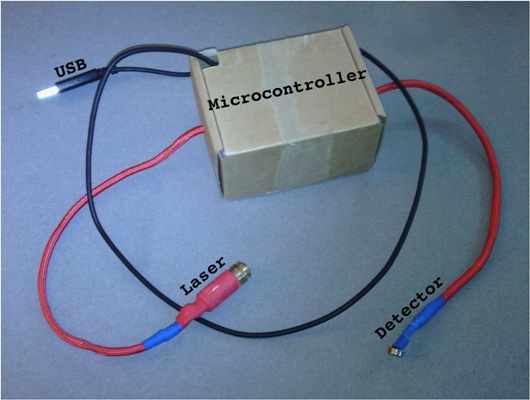
Google’s Chrome OS team #-Link-Snipped-# to unveil their new device that helps measure responsiveness of laptop touchpads. The device titled Quickstep has been developed to help Chromebook manufactures accurately measure the drag latency of their touchpads. Drag latency is the time taken between the user’s input on the touchpad and its corresponding response on the system. Before we go ahead and discuss about the innards of the Quickstep we shall tell you how it works. The laser on-board Quickstep is shined across the touchpad and its detector is placed on the opposite end. Once the user puts his/her finger on the touchpad the laser beam is broken and the time is noted in a log. Another log created by Quickstep device driver on the laptop stores the values from the firmware. An offline Python script is then executed to find the latency estimates. For your convenience and viewing pleasure we have attached the demonstration of Quickstep in the video below.
Now you would be thinking of all the mega engineering projects in the world, why we took time to bring you news about a rather rudimentary device? The answer is simple; the device that you saw in the video clip above is a DIY one. All you need is Teensy 3.0 development board, photodiode (Mouser P/N 78-BPW21R) with a resistor for the voltage divider and a Laser module to get started. Once you have procured the aforementioned products you have to follow the instructions found on <a href="https://docs.google.com/document/d/1B3GfZkwAfHlQE5kAuHcn-wq8I-7D5UF2Ap7C_CYk5co/edit" target="_blank" rel="nofollow noopener noreferrer">Quickstep Usage (Touch device drag-latency measurement) - Google Docs</a> and you have got your own Quickstep. Before you head out to build the Quickstep yourself we would like to make a few things clear. The Quickstep only measures drag-latency and not tap latency. The latency time measurement takes into consideration the gap between the sensor and the touch controller firmware and does not involve the graphics stack. The Quickstep is not meant to be an end-to-end solution as it measures low-level latency.
Now you would be thinking of all the mega engineering projects in the world, why we took time to bring you news about a rather rudimentary device? The answer is simple; the device that you saw in the video clip above is a DIY one. All you need is Teensy 3.0 development board, photodiode (Mouser P/N 78-BPW21R) with a resistor for the voltage divider and a Laser module to get started. Once you have procured the aforementioned products you have to follow the instructions found on <a href="https://docs.google.com/document/d/1B3GfZkwAfHlQE5kAuHcn-wq8I-7D5UF2Ap7C_CYk5co/edit" target="_blank" rel="nofollow noopener noreferrer">Quickstep Usage (Touch device drag-latency measurement) - Google Docs</a> and you have got your own Quickstep. Before you head out to build the Quickstep yourself we would like to make a few things clear. The Quickstep only measures drag-latency and not tap latency. The latency time measurement takes into consideration the gap between the sensor and the touch controller firmware and does not involve the graphics stack. The Quickstep is not meant to be an end-to-end solution as it measures low-level latency.