
EU & Japan Hoping For 100Gbps Fiber Optic Networks Through STRAUSS Project

Kaustubh Katdare

Kaustubh Katdare

@thebigk Oct 22, 2024
You know what? Google's 1Gbps optic fiber network is a thing of the past already. What's cool is 100Gbps Internet. Japan and European Union have embarked on a series of research projects that'd redefine the connectivity forever. The STRAUSS project - will aim for development of a 100Gbps fiber optic network. Once developed, it would offers 5000 times the average internet connection speed Europe and Japan are getting at present. The project involves research on optical packet switching technology, optical transceivers and other hardware components working in sync with a new control software. EU and Japan will donate €18 million to the project. Both countries expect that the web traffic will grow 12x in the next 5 years.

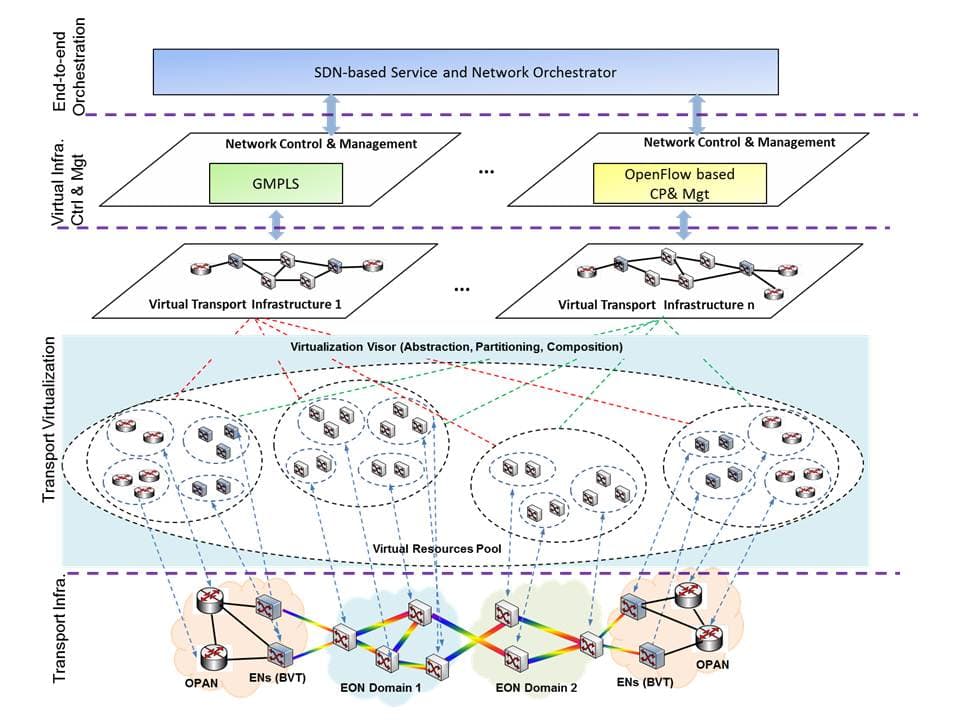
The SRAUSS project stands for scalable and efficient orchestration of ethernet services using software-defined and flexible optical networks. It will aim to define a high efficiency, global optical fiber network for ethernet transport.
strauss

The project will particularly focus on developing cost and energy efficient switching nodes, flexi-grid DWDM optical circuit switching technology and long haul transport along with development of integrated and highly scalable software systems to control the networks etc.

Via: #-Link-Snipped-#

Replies

Welcome, guest

Join CrazyEngineers to reply, ask questions, and participate in conversations.

CrazyEngineers powered by Jatra Community Platform

  • Anil Jain

    Anil Jain

    @CrazyBoy Jul 5, 2013

    I have used the 1GBPS.
    Oh Man! can't tell you the what a experience it was.

    I never used internet much faster than that. I was just wondering that do we have any limits on our wish. I was thinking that there is nothing in the world that would require more than 1GBPS.

    Do we really need 100 GBPS, or it is just to prove that they are GREATT?

    -CB
  • Jeffrey Arulraj

    Jeffrey Arulraj

    @jeffrey-xA7lUP Jul 5, 2013

    crazyboy
    I have used the 1GBPS.
    Oh Man! can't tell you the what a experience it was.

    I never used internet much faster than that. I was just wondering that do we have any limits on our wish. I was thinking that there is nothing in the world that would require more than 1GBPS.

    Do we really need 100 GBPS, or it is just to prove that they are GREATT?

    -CB
    I don't think 100 GBps line will be used by an individual economically Mostly a firm may set their servers up using these lines to provide faster access to their Customers

    Still 100GBps can't be utilised properly now by any action online
  • Kaustubh Katdare

    Kaustubh Katdare

    @thebigk Jul 5, 2013

    Well, we would definitely need 100 Gbps. Imagine the kind of bandwidth we'd need to stream 4k or 8k streams in future. My prediction is that the we would always need a faster Internet connection than what's currently available. I think engineers will quickly discover the ways of using all the bandwidth available.
  • Abhishek Rawal

    Abhishek Rawal

    @abhishek-fg9tRh Jul 5, 2013

    Kaustubh Katdare
    Well, we would definitely need 100 Gbps. Imagine the kind of bandwidth we'd need to stream 4k or 8k streams in future. My prediction is that the we would always need a faster Internet connection than what's currently available. I think engineers will quickly discover the ways of using all the bandwidth available.
    Agreed!
    As the resolution of the Monitor/TV screen increases, we'll need higher bandwidth internet.
    But, I believe that if 12-16 Mbps bandwidth is capable of streaming 1080p without buffering, then for 4K resolution; 48 or 64 Mbps (12 or 16 x 4 times) is capable of streaming the video.

    100Gbps is more than required.
  • Kaustubh Katdare

    Kaustubh Katdare

    @thebigk Jul 5, 2013

    It's more than required at now, just like people thought 64kb RAM would be more than enough just a few years ago. In the last decade itself, which I witnessed, the growth in tech has been exceptional. I think we'd find out ways to make 100Gbps look not enough.
  • Sarathkumar Chandrasekaran

    Sarathkumar Chandrasekaran

    @sarathkumar-FEGRPw Jul 5, 2013

    There is no limit for engineering.
    The only thing that harpens me is how is it useful for a individual usage.It may increase the efficiency of servers.But what to do ?
    The answer may be the development of higher end devices mor than 4g
  • Ashraf HZ

    Ashraf HZ

    @Ash Jul 6, 2013

    The breakthrough here is not the 100Gbps. Telco vendors have already developed equipment (with DWDM & SDH, etc) achieving these throughput with optical DSPs, and are now aiming for commercialization 400Gbps in a year or two. In fact, 800Gbps has already been started in trials.

    What this research focuses is on cost, software control and virtualization of optical packet based infrastructure for EU & Japan industries and academia.
  • Anoop Mathew

    Anoop Mathew

    @anoop-FRTf1L Jul 6, 2013

    As communication through internet keeps booming, we'd definitely need more bandwidth. The future of communication lies with VoIP and thus you can imagine a more stable and larger infrastructure requirement in the near future. Most of our telecom companies are already using VoIP to gain profits. The international market is definitely a huge playground with competition heating up with big players every single day!
  • Ashraf HZ

    Ashraf HZ

    @Ash Jul 6, 2013

    anoopthefriend
    As communication through internet keeps booming, we'd definitely need more bandwidth. The future of communication lies with VoIP and thus you can imagine a more stable and larger infrastructure requirement in the near future. Most of our telecom companies are already using VoIP to gain profits. The international market is definitely a huge playground with competition heating up with big players every single day!
    Agreed, VoIP works very well with global interconnects. However, on mobile networks, the challenge still lies with using VoIP on the air interface with reliability. On LTE networks, VoLTE would probably be the more reliable choice than VoIP by virtue of dedicated QoS & upcoming VoLTE dedicated hardware.

    Btw anoop, in your VoIP work, are you monitoring a mix of SIP & H.323 traffic? Which one is the most popular in your network so far?
  • Anoop Mathew

    Anoop Mathew

    @anoop-FRTf1L Jul 6, 2013

    ash
    Btw anoop, in your VoIP work, are you monitoring a mix of SIP & H.323 traffic? Which one is the most popular in your network so far?
    H.323 uses full proxy transport of media and is used mostly for video conferencing. I've used SIP more which transports mainly the signal and is used widely for voice communications along with certain codecs such as G.729, G.729A, G.729B and G.729A/B. #-Link-Snipped-# is a good comparison of SIP vs H.323.
  • Ashraf HZ

    Ashraf HZ

    @Ash Jul 6, 2013

    anoopthefriend
    H.323 uses full proxy transport of media and is used mostly for video conferencing. I've used SIP more which transports mainly the signal and is used widely for voice communications along with certain codecs such as G.729, G.729A, G.729B and G.729A/B. #-Link-Snipped-# is a good comparison of SIP vs H.323.
    I see, so mostly SIP based. I asked because I used to work with VoIP as well in 2010, and back then we interconnected both SIP & H.323 (from G.711 to G.729 codecs). It was a mess and a headache. I was hoping the landscape has changed by now. So I suppose more providers are moving entirely to SIP? That would help accelerate VoIP interconnects.

    What SBCs are your company using?
  • Anoop Mathew

    Anoop Mathew

    @anoop-FRTf1L Jul 6, 2013

    ash
    I see, so mostly SIP based. I asked because I used to work with VoIP as well in 2010, and back then we interconnected both SIP & H.323 (from G.711 to G.729 codecs). It was a mess and a headache. I was hoping the landscape has changed by now. So I suppose more providers are moving entirely to SIP? That would help accelerate VoIP interconnects.

    What SBCs are your company using?

    Mediacore and AcmePacket. Yes, SIP is mostly used as far as I've seen. We've a trans-coding device to transfer all codecs to G.729. However, we'll soon be trying out on the media part as well.