

An Unusual Venusian Oval

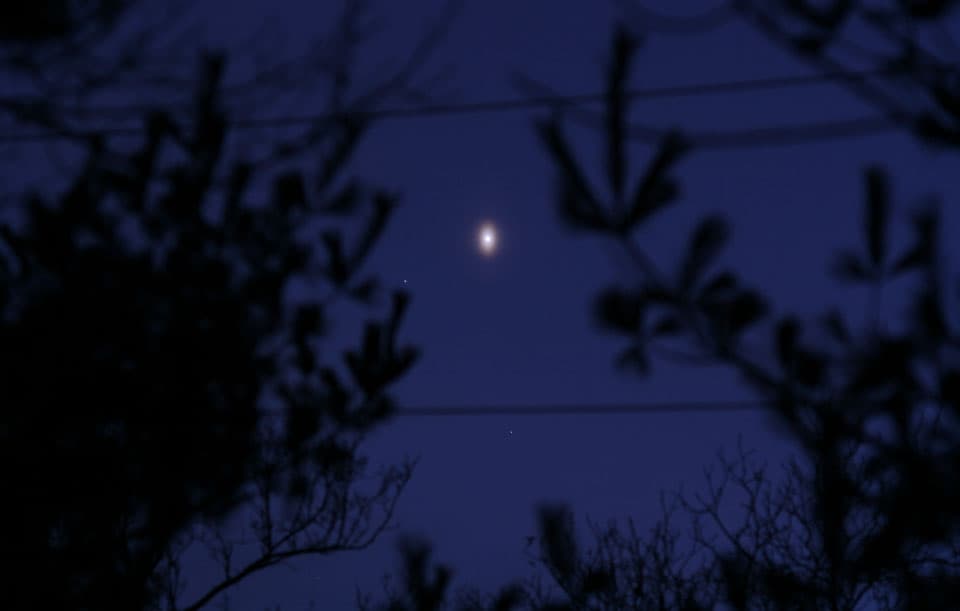
Explanation: Why would Venus appear oval? <a href="https://apod.nasa.gov/apod/ap101020.html" target="_blank" rel="nofollow noopener noreferrer">APOD: 2010 October 20 - Venus Just After Sunset</a> has been seen countless times from the surface of the Earth, and every time the <a href="https://en.wikipedia.org/wiki/Atmosphere_of_Earth" target="_blank" rel="nofollow noopener noreferrer">Atmosphere Of Earth</a> has dispersed its light to some degree. When the air has just the right amount of dust or water droplets, small but distant objects like Venus appear spread out into an angularly large aureole. Aureoles are not unusual to see and are frequently noted as circular #-Link-Snipped-# around the <a href="https://apod.nasa.gov/apod/ap100208.html" target="_blank" rel="nofollow noopener noreferrer">APOD: 2010 February 8 - A Sun Halo Over Cambodia</a> or <a href="https://apod.nasa.gov/apod/ap081207.html" target="_blank" rel="nofollow noopener noreferrer">APOD: 2008 December 7 - A Halo Around the Moon</a>. Recently, however, aureoles have been imaged that are not circular but distinctly #-Link-Snipped-#. The above oval Venusian aureole was imaged by the #-Link-Snipped-# who first noted the unusual phenomenon three years ago. Initially disputed, the #-Link-Snipped-# has now been #-Link-Snipped-# by several different astrophotographers. What causes the ellipticity is #-Link-Snipped-#, and although several #-Link-Snipped-# that horizontally oriented #-Link-Snipped-#, significant #-Link-Snipped-# about it are still taking place.
<a href="https://apod.nasa.gov/apod/ap120213.html" target="_blank" rel="nofollow noopener noreferrer">APOD: 2012 February 13 - An Unusual Venusian Oval</a>