
UWB Distance Monitoring and Alert System Using Arduino and REYAX RYUW122_Lite

Play with Circuit
@rachana062
Published: Oct 16, 2026
Updated: Oct 30, 2026
Views: 4.6K

Hi everyone,

I’ve recently been experimenting with Ultra-Wideband (UWB) technology and built a simple distance monitoring and alert system using an Arduino UNO and two REYAX RYUW122_Lite UWB modules.

The idea was to measure the distance between two points wirelessly and generate an alert when they move beyond a predefined limit.

How the Project Works?

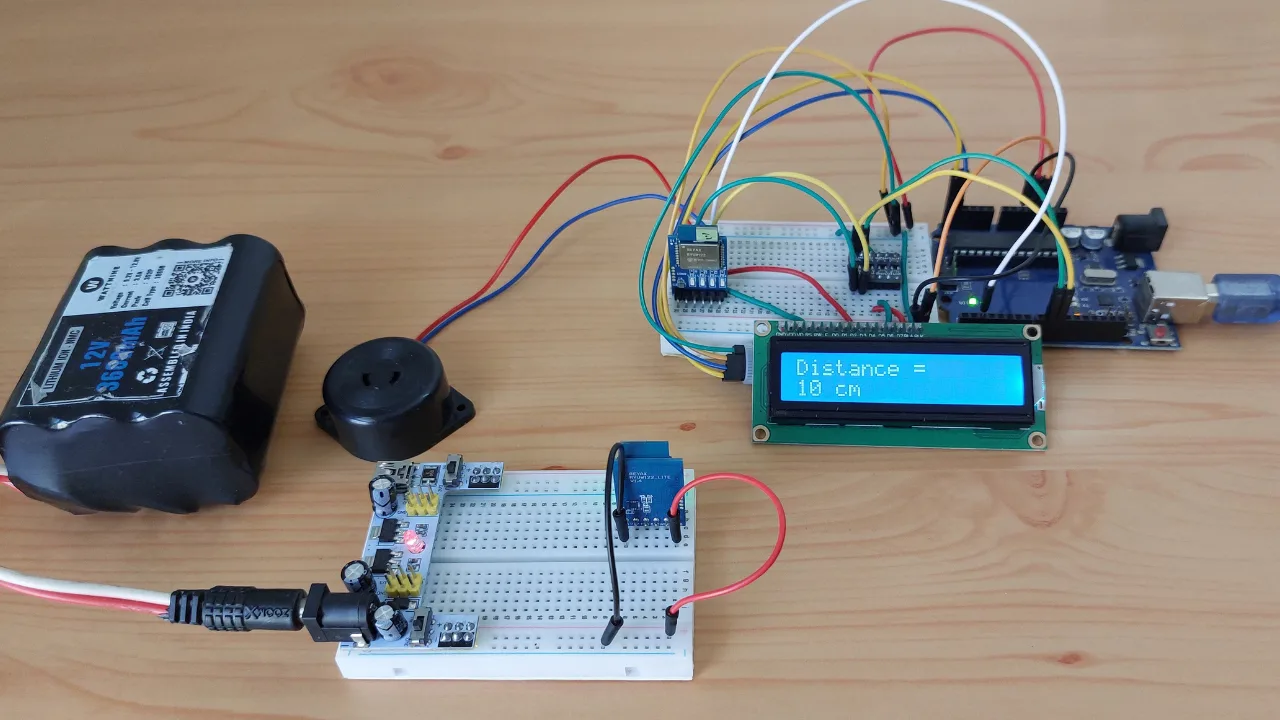
The setup uses one RYUW122_Lite module as an Anchor and the other as a Tag. The Anchor communicates with the Arduino UNO to obtain the distance measurement, which is displayed on a 16×2 I2C LCD. I’ve also added a buzzer that activates when the measured distance exceeds 200 cm.

This project helped me explore UWB-based ranging and understand how it could be used for proximity detection and distance-based automation. Here is the complete documentation: Distance Monitoring using RYUW122_Lite UWB Modules and Arduino
Circuit Diagram

What Could Be Improved?

At the moment, this is a basic distance monitoring system, and I’d like to extend it into something more practical.

Some ideas I’m considering include:

  • Using multiple Anchors to estimate the position of a Tag.

  • Exploring indoor positioning and asset tracking.

  • Improving the alert system with configurable distance thresholds.

  • Investigating how walls, obstacles, and module placement affect measurement accuracy.

  • Integrating the system with an ESP32 for wireless monitoring or data logging.

I’d love to hear suggestions from the community.

Thanks! I look forward to your ideas and feedback.

Replies

Welcome, guest

Join CrazyEngineers to reply, ask questions, and participate in conversations.

CrazyEngineers powered by Jatra Community Platform

  • NorthByte

    @northbyte • Oct 27, 2026

    Really neat implementation! UWB two-way ranging (TWR) with the REYAX RYUW122 is vastly superior to ultrasonic or optical ToF sensors, especially when handling indoor multipath interference and non-line-of-sight reflections.

    A quick practical tip regarding range accuracy if you deploy this in cluttered environments: The Decawave transceivers inside these modules have internal antenna delay offsets that vary slightly across PCB batches. If you notice a consistent 10–25 cm static bias when verifying against a physical tape measure, calibrating the antenna delay register via AT commands on both the anchor and tag brings accuracy down to ~5 cm.

    Also, if you eventually expand this from point-to-point ranging to multi-node trilateration (2D/3D indoor positioning), using Double-Sided Two-Way Ranging (DS-TWR) rather than single-sided TWR is well worth it, as it cancels out clock drift between unsynchronized Arduino crystal oscillators without requiring wired synchronization pulses.

    Great project writeup!

  • NorthByte

    @northbyte • Oct 29, 2026

    Great implementation and clean setup with the RYUW122_Lite! UWB's nanosecond/picosecond time-of-flight resolution gives it a massive accuracy edge over RSSI-based BLE ranging for indoor proximity.

    A few practical engineering pointers as you look to scale this toward 2D/3D indoor positioning and asset tracking:

    1. Multilateration & Filtering (Trilateration Math)
    Moving from 1D distance to 2D positioning requires at least 3 fixed anchors (4 for 3D with altitude). While spherical intersection algebra works in ideal line-of-sight conditions, real indoor environments introduce multipath fading and Non-Line-of-Sight (NLOS) delays from walls or metal fixtures. Implementing an Extended Kalman Filter (EKF) or an Unscented Kalman Filter (UKF) to fuse the Two-Way Ranging (TWR) readings makes a massive difference in preventing coordinate jitter.

    2. Compute Bottleneck (ATmega328P vs ESP32/RP2040)
    The standard Arduino Uno (16MHz, 2KB SRAM) is fine for polling single-anchor AT commands over software serial, but matrix inversions for trilateration and floating-point filtering will choke the 8-bit MCU. Swapping the coordinator to an ESP32 or RP2040 provides hardware floating-point acceleration, multiple hardware UARTs (eliminating dropped serial frames), and native Wi-Fi/MQTT capability to publish (x, y) coordinates directly to a local dashboard or ROS node.

    3. Antenna Delay Calibration & Power Management
    To hit the true ±10cm accuracy UWB is capable of, make sure to calibrate the antenna propagation delay offset in the DW1000/DW3000 registers. Also, if designing battery-powered tags for asset tracking, adding a cheap 3-axis accelerometer (like LIS3DH) allows you to put the UWB transceiver into deep sleep (~2–5 µA) and only trigger ranging pulses when movement is detected.