

Turning Glass Into Metal Possible Using Laser Pulse - Vienna University of Technology

@abrakadabra
•
Oct 26, 2024
Oct 26, 2024
1.4K
Researchers from the Vienna University of Technology TU Wien) have been able to successfully demonstrate how quartz glass can exhibit the properties of a metal (for fractions of a second) when it's hit by a laser pulse. We all know that the Quartz Glass is commonly known and used as an insulator, due to its inability to conduct electricity. In what seems like a fundamental change in the history of physics, the scientists at Vienna have made it possible to turn the glass into metal using ultra-short laser. Interestingly enough, this change of material properties (from glass to metal) happens at such a fast speed that they become ideal for use in ultra-fast light based electronics.
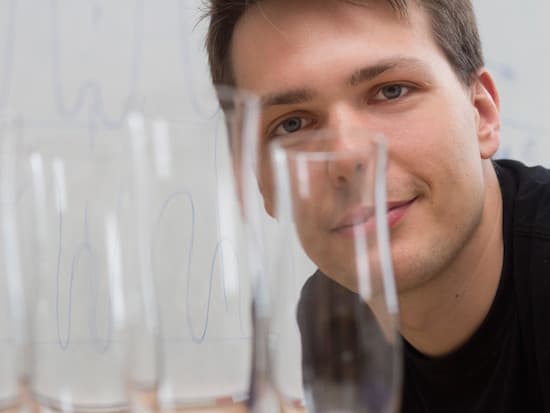
Georg Wachter - A researcher
By teaming up with the research team from Tsukuba University in Japan, Georg Wachter, Christoph Lemell and Professor Joachim Burgdörfer from TU Wien have been able to conduct an experiment where electric current is measured in quartz glass, while it's illuminated by a laser pulse, and the material could immediately returns to its original state, once the laser is turned off. It has to be noted here that the laser pulse is nothing but an extremely strong electrical field. So powerful that it completely changes the structure of electron states of a material. To explain this, the research teams share the example of a little ball's behavior on a dented surface. With little energy, it remains in one of the dents, but if it's kicked with all your might, it starts moving around freely. That's how this works and this has all been possible due to Quantum Mechanics, where an electron is able to occupy different states in a solid material.
By distorting the structure of electron states, the oxygen atom's electron found in the quartz glass can now suddenly become a free electron that's at the core of any normal metal. At play here is the laser pulse's electric field which gives all these free electrons a single direction, thus enabling the electric current to start flowing.
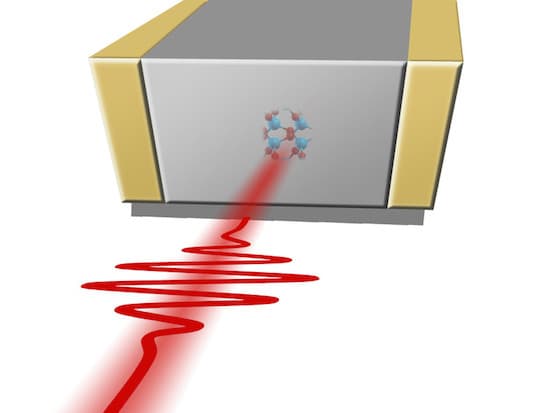
A laser pulse hits the quartz glass between two electrodes.
Now this project involves having many quantum processes happening simultaneously, making it extremely complex to deal with. It is only with the possible with the help of supercomputers that the electronic structure of the material and interaction between the laser and electron as well as the interactions between the electrons can be calculated. Their computer simulations helped them study the changes happening in the Quartz Glass using slow motion techniques.
In modern day transistors, during each switching operation, a large number of charge carriers move until a new equilibrium state is reached. With this experiment, it has now come to light that laser pulses are able to switch electric currents a 1000 times faster than transistors, which normally work on a time scale of picoseconds.
What are your thoughts on the new physics experiment? Share with us in comments below.
Source: #-Link-Snipped-#
Georg Wachter - A researcher
By teaming up with the research team from Tsukuba University in Japan, Georg Wachter, Christoph Lemell and Professor Joachim Burgdörfer from TU Wien have been able to conduct an experiment where electric current is measured in quartz glass, while it's illuminated by a laser pulse, and the material could immediately returns to its original state, once the laser is turned off. It has to be noted here that the laser pulse is nothing but an extremely strong electrical field. So powerful that it completely changes the structure of electron states of a material. To explain this, the research teams share the example of a little ball's behavior on a dented surface. With little energy, it remains in one of the dents, but if it's kicked with all your might, it starts moving around freely. That's how this works and this has all been possible due to Quantum Mechanics, where an electron is able to occupy different states in a solid material.
By distorting the structure of electron states, the oxygen atom's electron found in the quartz glass can now suddenly become a free electron that's at the core of any normal metal. At play here is the laser pulse's electric field which gives all these free electrons a single direction, thus enabling the electric current to start flowing.
A laser pulse hits the quartz glass between two electrodes.
Now this project involves having many quantum processes happening simultaneously, making it extremely complex to deal with. It is only with the possible with the help of supercomputers that the electronic structure of the material and interaction between the laser and electron as well as the interactions between the electrons can be calculated. Their computer simulations helped them study the changes happening in the Quartz Glass using slow motion techniques.
In modern day transistors, during each switching operation, a large number of charge carriers move until a new equilibrium state is reached. With this experiment, it has now come to light that laser pulses are able to switch electric currents a 1000 times faster than transistors, which normally work on a time scale of picoseconds.
What are your thoughts on the new physics experiment? Share with us in comments below.
Source: #-Link-Snipped-#