
Timer Charger

Abhijeet Khandagale

Abhijeet Khandagale

@abhijeet-gu2Sj7 Oct 23, 2024
I'm planning to build a hobby project. A simple add on for chargers which can be set to charge a device for a specific time and then cut off from mains. Any suggestions? I'm planning to use a 555 and build it.

Replies

Welcome, guest

Join CrazyEngineers to reply, ask questions, and participate in conversations.

CrazyEngineers powered by Jatra Community Platform

  • Ankita Katdare

    Ankita Katdare

    @abrakadabra Jul 17, 2014

    #-Link-Snipped-# #-Link-Snipped-# #-Link-Snipped-# #-Link-Snipped-# #-Link-Snipped-# #-Link-Snipped-# might be of help.
  • Harshad Italiya

    Harshad Italiya

    @harshad-ukH5ww Jul 17, 2014

    abhijeetkhan
    I'm planning to build a hobby project. A simple add on for chargers which can be set to charge a device for a specific time and then cut off from mains. Any suggestions? I'm planning to use a 555 and build it.
    You can choose either 555 or microcontroller to control relay and relay will cut on and off your power.
    Have a look at this diagram and let us know what you get from that?
    [​IMG]
  • Ramani Aswath

    Ramani Aswath

    @ramani-VR4O43 Jul 17, 2014

    What is the problem with implimenting that? Seems straight forward If you are looking for long duration timing circuits have a look here:
    #-Link-Snipped-#
  • Abhijeet Khandagale

    Abhijeet Khandagale

    @abhijeet-gu2Sj7 Jul 17, 2014

    I want to make a small add on in the power plug. Just a bit confused whether to use a 555 or something else. Also, to power the circuit, should i used an external battery or draw power from mains itself?
  • Ramani Aswath

    Ramani Aswath

    @ramani-VR4O43 Jul 17, 2014

    I doubt if all components of the timer circuit (including the time setting input (a pot?) can be accommodated in a plug. Best to incoporate the circuit on the board of a mains adaptor circuit.
  • Abhijeet Khandagale

    Abhijeet Khandagale

    @abhijeet-gu2Sj7 Jul 17, 2014

    Harshad Italiya
    You can choose either 555 or microcontroller to control relay and relay will cut on and off your power.
    Have a look at this diagram and let us know what you get from that?
    [​IMG]
    Yeah this is simple. What combinations of CR can get a 1, 2, 3hr cycle?
  • Ramani Aswath

    Ramani Aswath

    @ramani-VR4O43 Jul 17, 2014

    Even with a 50K ohms resistor you will need a huge capacitor (about 100,000 mF) to get about one and half hours. It will not be very reliable.
    You may have to consider a 556 or two 555s and a cascaded design for reliable long delays.
  • Harshad Italiya

    Harshad Italiya

    @harshad-ukH5ww Jul 18, 2014

    abhijeetkhan
    Yeah this is simple. What combinations of CR can get a 1, 2, 3hr cycle?
    One option is as Ramani Sir said use cascade mode but I would like to suggest use of some basic microcontroller like 8051 will be better for you. I see you are from mechanical stream but it won't be too much difficult.
    If you want to give it a start we can help you. 😀
  • Abhijeet Khandagale

    Abhijeet Khandagale

    @abhijeet-gu2Sj7 Jul 20, 2014

    #-Link-Snipped-# #-Link-Snipped-# I guess i'll take the uC route. An 8pin PIC should work right? I've had some experience in electronics, but its been a few years I haven't done anything hands on.
    One doubt I have is to power the uC circuit, an SMPS might work. But since there is another device which will also power through the same point, is there a chance of high power loss?
  • Harshad Italiya

    Harshad Italiya

    @harshad-ukH5ww Jul 20, 2014

    abhijeetkhan
    #-Link-Snipped-# #-Link-Snipped-# I guess i'll take the uC route. An 8pin PIC should work right? I've had some experience in electronics, but its been a few years I haven't done anything hands on.
    One doubt I have is to power the uC circuit, an SMPS might work. But since there is another device which will also power through the same point, is there a chance of high power loss?
    It mostly depends on the load. But as far as you are going with SMPS you should be fine. Still do share rough sketch if possible and keep us updated with your progress.
  • Ramani Aswath

    Ramani Aswath

    @ramani-VR4O43 Jul 20, 2014

    Another option is to monitor the voltage of the battery being charged. Once the voltage of the battery reachesthe fully charged value a simple Zener circuit can be used to cut of a triac which is used to switch on the mains input to the charger. No timing is involved.
    I used this to regulate the charging of a remotely located gen set starter motor battery. Worked for years without attention and without water loss from the lead acid battery.
  • Abhijeet Khandagale

    Abhijeet Khandagale

    @abhijeet-gu2Sj7 Jul 20, 2014

    A.V.Ramani
    Another option is to monitor the voltage of the battery being charged. Once the voltage of the battery reachesthe fully charged value a simple Zener circuit can be used to cut of a triac which is used to switch on the mains input to the charger. No timing is involved.
    I used this to regulate the charging of a remotely located gen set starter motor battery. Worked for years without attention and without water loss from the lead acid battery.
    But how to measure for different devices? The final output I'm looking at is: I set in a charge time of 2hours for my cellphone, and 3 for my laptop and I can have a fully charged device when I'm awake, without the fear of it being overcharged, heating up.
  • Harshad Italiya

    Harshad Italiya

    @harshad-ukH5ww Jul 20, 2014

    abhijeetkhan
    But how to measure for different devices? The final output I'm looking at is: I set in a charge time of 2hours for my cellphone, and 3 for my laptop and I can have a fully charged device when I'm awake, without the fear of it being overcharged, heating up.
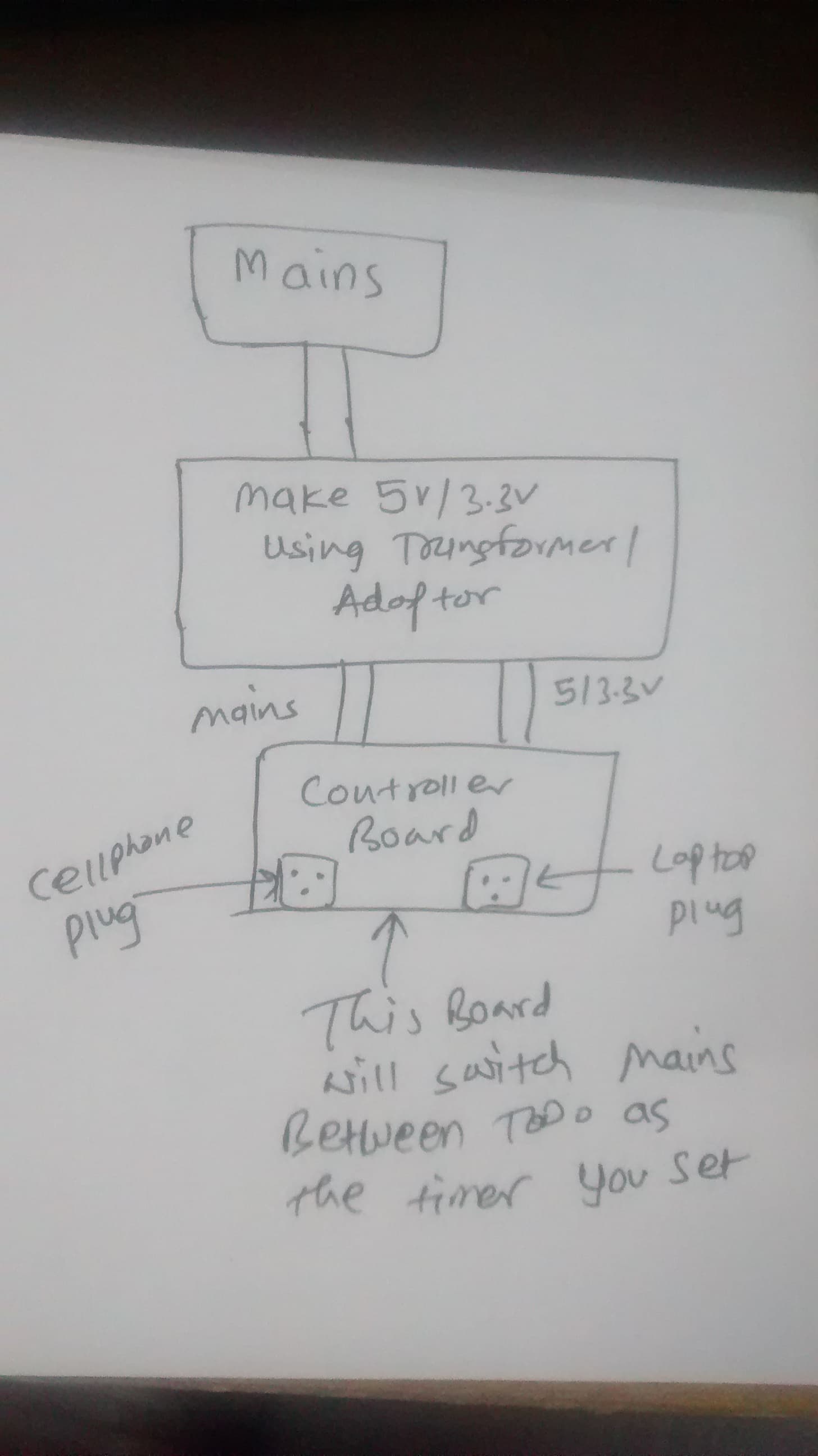
    In this case you must having different power adapter for cellphone and laptop. So you need to design dedicated supply for your circuit which can switch your main AC power between your Cellphone adapter and laptop adapter.
  • Ramani Aswath

    Ramani Aswath

    @ramani-VR4O43 Jul 21, 2014

    The circuit I mentioned has a set pot which can be set to any voltage below the maximum OP voltage of your charger. Your problem is also to adjust the current for different devices.
    A laptop may take a much higher current than a cell phone. I do not even use a laptop. I am rather hazy on this.

    Harshad is much more competent to advise on this.
  • Harshad Italiya

    Harshad Italiya

    @harshad-ukH5ww Jul 21, 2014

    A.V.Ramani
    The circuit I mentioned has a set pot which can be set to any voltage below the maximum OP voltage of your charger. Your problem is also to adjust the current for different devices.
    A laptop may take a much higher current than a cell phone. I do not even use a laptop. I am rather hazy on this.

    Harshad is much more competent to advise on this.
    Here is my simple idea

    IMG_20140721_193815248
  • lal

    lal

    @lal-R60Xjx Jul 21, 2014

    I had something similar in my mind before it gave way to making a portable charger and incorporating automatic charging cut off there. It's been quite a while since I looked back in the whole idea.

    Any way, if a timer is what we make, it wouldn't be complete. In other words, not compatible with all sizes of batteries. Different batteries with different capacities differ on charging time. So the next thing was to try monitoring load/battery voltage and cut off charging when it was of the rated value. Again, these phones don't allow battery voltage to be monitored from the charging port. If we need to monitor the battery voltage, a need for extra connections (rather clumsy) would be needed. Still, such a connection can't be reliable. It has to be a 'plug in and sleep' solution, but not much fiddling involved.

    Then the best solution I guess is to monitor charging current. At fully charged state, charging current will be feable, fair enough to trigger a solid state switch to cut off the supply, once detected. I was stuck at this point last time I looked in to it. First, I thought of connecting a series variable resistor to the charging line and monitor voltage drop across it and thus indirectly monitor current, as monitoring voltage is far more simpler than current (I guess). Since I was planning a portable charger, I didn't want any more losses. Besides, that didn't look like much of a right way either. Was searching for a cheap IC that could detect current then. I'm stuck at this point 😁
  • Harshad Italiya

    Harshad Italiya

    @harshad-ukH5ww Jul 21, 2014

    #-Link-Snipped-# I think #-Link-Snipped-# want just to change power source from one adapter to another as he want to charge his mobile and Laptop fully during night time. So like he knows that Cellphone is taking up 1hr or 1.5hr so he setup time say 2 hr give supply to Cellphone charger and next 4hr supply power to laptop charger so when he wake-up there his phone and laptop both charges fully.

    So after all he is using the company cellphone and laptop charger only so there is no need to take any extra care to check battery is fully charged or not as cellphone and laptop itself cuts power when battery fully charged.
  • Abhijeet Khandagale

    Abhijeet Khandagale

    @abhijeet-gu2Sj7 Jul 21, 2014

    I liked #-Link-Snipped-# 's way. in lines with what #-Link-Snipped-# was trying to say. I was thinking a similar architecture as you said #-Link-Snipped-# . I'm really sure of how many devices offer that functionality, recently its been incorporated at a wide level. Getting the rust of my mind with this project 😀
  • lal

    lal

    @lal-R60Xjx Jul 22, 2014

    #-Link-Snipped-# bhai. That looks like a much simpler and easier approach. In that case, I guess, a change over time-delay relay may be chosen over electronic circuits. Would be quite rugged and need no extra circuit to power it. If it is set to, say two hours, it would change over automatically after the specified time.

    The problem here is the 'change over' connection part. It would stay connected in the changed over state without cutting off power to second device.

    Or a simple normally open time-delay relay will do the job. Both the plug outlets may be fed directly through the same contact of relay (in parallel), since the load is quite small. Setting three hours delay should charge both the devices I guess.
  • Abhijeet Khandagale

    Abhijeet Khandagale

    @abhijeet-gu2Sj7 Jul 22, 2014

    #-Link-Snipped-# #-Link-Snipped-# i found this thing online, can you help me tear apart the components ? Also they have just 1hr of delay; any suggestions on increasing it?

    #-Link-Snipped-#
  • Harshad Italiya

    Harshad Italiya

    @harshad-ukH5ww Jul 22, 2014

    abhijeetkhan
    #-Link-Snipped-# #-Link-Snipped-# i found this thing online, can you help me tear apart the components ? Also they have just 1hr of delay; any suggestions on increasing it?

    #-Link-Snipped-#
    Chip name is not visible but may be they have used some kind of timer IC only. And I think they have used very common parts although we can't say about exact part number until we got the board but from the look it seems some kind of standard Timer board only.
  • Harshad Italiya

    Harshad Italiya

    @harshad-ukH5ww Jul 22, 2014

    lal
    The problem here is the 'change over' connection part. It would stay connected in the changed over state without cutting off power to second device.
    Changeover is also simple even with single relay we can achieve that. Make Neutral common for both socket and switch over Phase to NO and NC pin of relay so at a time there will be only one socket have active power source.
  • Ramani Aswath

    Ramani Aswath

    @ramani-VR4O43 Jul 22, 2014

    How about this?
    <a href="https://www.brighthubengineering.com/diy-electronics-devices/63900-make-yourself-a-simple-versatile-long-duration-timer/" target="_blank" rel="nofollow noopener noreferrer">How to Build a Long Duration Timer? One Sample Circuit Explained with a Schematic - Bright Hub Engineering</a>
  • lal

    lal

    @lal-R60Xjx Jul 23, 2014

    Harshad Italiya
    Changeover is also simple even with single relay we can achieve that. Make Neutral common for both socket and switch over Phase to NO and NC pin of relay so at a time there will be only one socket have active power source.
    But, at any given time one contact will be closed and the other open. The problem is for the second state of relay. For instance, if a time delay of 2 hours is set, one socket will be powered for the first two hours and then the relay changes state. Starting from that moment, the first socket will be open and the second powered indefenitely. There is no control over time when the relay is in second state. It'll stay like that until some one operates it.
  • Harshad Italiya

    Harshad Italiya

    @harshad-ukH5ww Jul 23, 2014

    lal
    But, at any given time one contact will be closed and the other open. The problem is for the second state of relay. For instance, if a time delay of 2 hours is set, one socket will be powered for the first two hours and then the relay changes state. Starting from that moment, the first socket will be open and the second powered indefenitely. There is no control over time when the relay is in second state. It'll stay like that until some one operates it.
    Oh ! Yeah in that case you are right. So now it depends on how #-Link-Snipped-# want to use. 😀