
'Perfect Defects' In Graphene Pave Way For Futuristic Gadgets

@chaitanya-kukde-yk3G31
•
Oct 25, 2024
Oct 25, 2024
1.5K
Even if you are not a keen follower of the updates in the materials technology, chances are slim of not having heard of the supermaterial called Graphene. Graphene promises groundbreaking improvements in many electronics applications. The main problem manufacturers, designers and scientists currently experience is that it is hard to commercially produce graphene sheets: a problem overcome by the scientists at Rice University who have created flexible, patterned sheets of multilayer graphene from a cheap polymer by burning it with a computer-controlled laser.
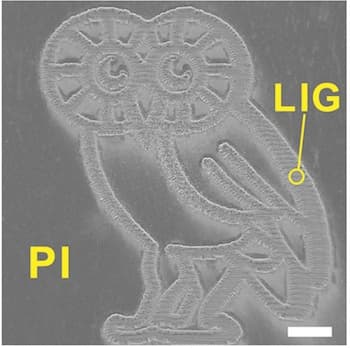
Rather than a perfect chicken wire-like structure, the Laser Induced Graphene (LIG) is a jumble of interconnected graphene flakes with five-, six- and seven-atom rings. These rings, wrongly called 'defects', actually make the material more metallic and and enhance its ability to store charges. Normal graphene has a six-atom ring- structure and it is highly conductive, i.e. it cannot possibly store any charge. The material is created using computer-controlled lasers which scrape away polymers exposed to lasers which scrape away most, if not all the material in the base material. Thus, rather than a 2-D sheet, we have a 20-micron thick layer of 'defective' graphene attached to an insulating, flexible plastic base.
The polymer used for the process were in the form of inexpensive polyimide sheets. The process also does not require high temperatures or vacuum, it is very fast and it is scalable. The researchers made a microsupercapacitor using this material. Their best effort showed capacitance of more than 4 millifarads per square centimeter and power density of about 9 milliwatts per square centimeter, comparable to other carbon-based microsupercapacitors, and negligible degradation after as many as 9,000 charge/discharge cycles.
This improvement could really accelerate improvements in the production process for wearable electronic gadgets, researchers James Tour and Boris Yakobson said. Their results were published in the Nature Communications Journal.
Source: #-Link-Snipped-#
Rather than a perfect chicken wire-like structure, the Laser Induced Graphene (LIG) is a jumble of interconnected graphene flakes with five-, six- and seven-atom rings. These rings, wrongly called 'defects', actually make the material more metallic and and enhance its ability to store charges. Normal graphene has a six-atom ring- structure and it is highly conductive, i.e. it cannot possibly store any charge. The material is created using computer-controlled lasers which scrape away polymers exposed to lasers which scrape away most, if not all the material in the base material. Thus, rather than a 2-D sheet, we have a 20-micron thick layer of 'defective' graphene attached to an insulating, flexible plastic base.
The polymer used for the process were in the form of inexpensive polyimide sheets. The process also does not require high temperatures or vacuum, it is very fast and it is scalable. The researchers made a microsupercapacitor using this material. Their best effort showed capacitance of more than 4 millifarads per square centimeter and power density of about 9 milliwatts per square centimeter, comparable to other carbon-based microsupercapacitors, and negligible degradation after as many as 9,000 charge/discharge cycles.
This improvement could really accelerate improvements in the production process for wearable electronic gadgets, researchers James Tour and Boris Yakobson said. Their results were published in the Nature Communications Journal.
Source: #-Link-Snipped-#