

New Carbon-Based Nanomaterial Allows For High Efficiency Batteries and Supercapacitors

A team of researchers from various geographies have succeeded in developing first of its kind, one-step process to create unique carbon-based nanomaterials that exhibits amazing thermal, electrical as well as mechanical properties in 3D. A fiber-like 3D supercapacitor developed using carbon nanotubes and graphene showed four-times increased capacity; very uncommon for a device of its type. When the material was used as a counter electrode in a dye-sensitized solar cell, the cell could convert power with about 6.8% efficiency; doubling the performance of a similar cell using platinum.
The carbon nanotubes are highly conducting along the 1D nanotube length and 2D graphene sheets in 2Dplane. However the material fails in 3D shape because of poor conductivity among the layers. Liming Dai, the lead researcher on the project informed that the 2-step process used in lab does not allow for having the desired conductance.
By developing a new one-step process, Dai and his team were able to use carbon-to-carbon bonding to create 3D nanomaterial that has desired electrical and thermal properties across all the planes.
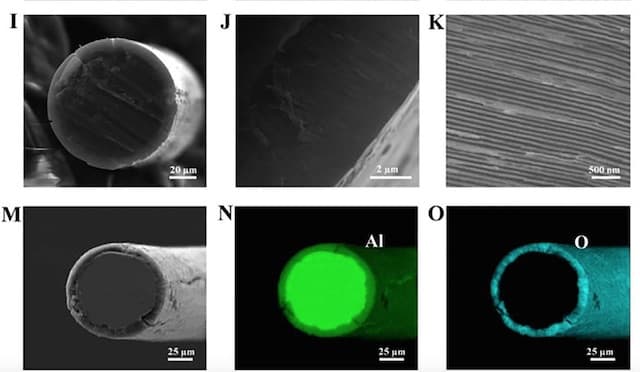
Image Credit: Credit: Xue et al. Science Advances 2015;1:1400198
The early laboratory tests have shown that the new material can be used as an ideal electrode for high-efficiency energy storage. It also allowed for capacitance by area reach to 89.4 millifarads/sq.cm and 23.9 millifarads/cm by length. The properties of the nanomaterial can be customised as needed. The one-step process allows the material to be made very long or in the shape of a tube with desired diameter.
Researchers say that the new material can be used for storing more charge in capacitors and batteries and also in storing hydrogen on large surface areas. More information about the research is available on the source link below.
Source: #-Link-Snipped-#