
NASA’s New Horizons Spacecraft Provides Images Of Pluto’s Two Moons: Nix And Hydra

@sharvari-panchbhai-JOvYc6
•
Oct 26, 2024
Oct 26, 2024
1.5K
After switching NASA’s ‘<a href="https://www.crazyengineers.com/threads/nasas-new-horizons-spacecraft-turned-up-for-rendezvous-with-pluto-system.77651">NASA's New Horizons Spacecraft Turned Up For Rendezvous With Pluto System</a>’ from hibernation to active mode while entering into Pluto system in December last year, the unmanned spacecraft has now provided the first views of the small moons orbiting Pluto. It has taken a series of images of the moons named Nix and Hydra from January 27 to February 8 and provided them exactly on the 85th anniversary of Pluto's discovery.
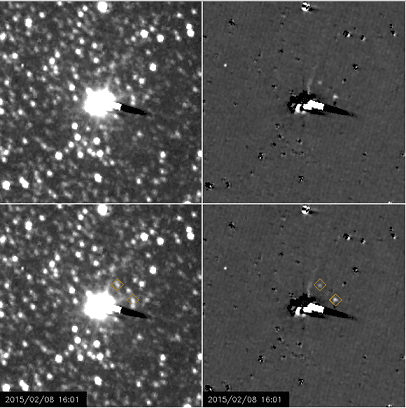
The new images were taken by the spacecraft at a distance ranging from about 115 to 125 million miles. Later, these images were assembled into a seven-frame movie that provides New Horizons’ first extended look at Hydra and its very first view of Nix. Moreover, the combinations of five 10-second images taken with space probe’s Long-Range Reconnaissance Imager (LORRI) constitute one frame of the movie. The high resolution imaging instrument, LORRI used a special mode that combines pixels for increasing sensitivity at the expense of resolution. The left-hand images show the moons, Nix and Hydra, against the glare of Pluto and Charon (Pluto’s largest natural satellite) accompanied by dense field of background stars. The images were processed and enhanced in order to get a clear view of Nix and Hydra by removing the glare of Pluto and Charon along with background stars (refer the right side of the images). The spacecraft will continue taking images of the moons till early March. This series of long-exposure images will surely help the team to know more about the moons’ orbits.
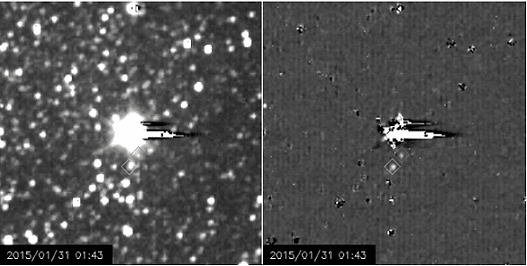
Nix and Hydra are about two to three times away from Pluto as compared to Charon and were discovered by NASA's Hubble Space Telescope in 2005. The outermost known moon, Hydra is at a distance of approximately 40,200 miles from Pluto and completes its orbit in 38 days. Whereas, Nix being the inner of the two moons is at a distance of 30,260 miles and orbits every 25 days. Both the moons are probably between 25-95 miles in diameter. However, scientists will come to know about their exact sizes in July, this year as New Horizons will obtain their close-up pictures. In addition, the other moons, Styx and Kerberos, will also become visible in the coming months.
Source: <a href="https://www.nasa.gov/nh_new-horizons-spots-small-moons-orbiting-pluto/index.html#.VOscW_mUftt" target="_blank" rel="nofollow noopener noreferrer">New Horizons Spots Small Moons Orbiting Pluto | NASA</a>
The new images were taken by the spacecraft at a distance ranging from about 115 to 125 million miles. Later, these images were assembled into a seven-frame movie that provides New Horizons’ first extended look at Hydra and its very first view of Nix. Moreover, the combinations of five 10-second images taken with space probe’s Long-Range Reconnaissance Imager (LORRI) constitute one frame of the movie. The high resolution imaging instrument, LORRI used a special mode that combines pixels for increasing sensitivity at the expense of resolution. The left-hand images show the moons, Nix and Hydra, against the glare of Pluto and Charon (Pluto’s largest natural satellite) accompanied by dense field of background stars. The images were processed and enhanced in order to get a clear view of Nix and Hydra by removing the glare of Pluto and Charon along with background stars (refer the right side of the images). The spacecraft will continue taking images of the moons till early March. This series of long-exposure images will surely help the team to know more about the moons’ orbits.
Nix and Hydra are about two to three times away from Pluto as compared to Charon and were discovered by NASA's Hubble Space Telescope in 2005. The outermost known moon, Hydra is at a distance of approximately 40,200 miles from Pluto and completes its orbit in 38 days. Whereas, Nix being the inner of the two moons is at a distance of 30,260 miles and orbits every 25 days. Both the moons are probably between 25-95 miles in diameter. However, scientists will come to know about their exact sizes in July, this year as New Horizons will obtain their close-up pictures. In addition, the other moons, Styx and Kerberos, will also become visible in the coming months.
Source: <a href="https://www.nasa.gov/nh_new-horizons-spots-small-moons-orbiting-pluto/index.html#.VOscW_mUftt" target="_blank" rel="nofollow noopener noreferrer">New Horizons Spots Small Moons Orbiting Pluto | NASA</a>