

NASA’s Kepler Telescope Discovers Three More Earth-Like Aka Habitable Planets

@jason-IQjfPQ
•
Oct 22, 2024
Oct 22, 2024
1.3K
Kepler Space Observatory was established back in 2009 for the purpose of finding Earth-like exoplanets. Exoplanets are those planets that orbit around some other star which is not the Sun. Since then the Kepler telescope has made some significant discoveries and in the process reached a significant landmark. In the recently held annual winter meeting of the American Astronomical Society, the officials of NASA announced that they've discovered 8 new exoplanets, thus taking the tally of the total exoplanets they found to a new milestone - 1004.
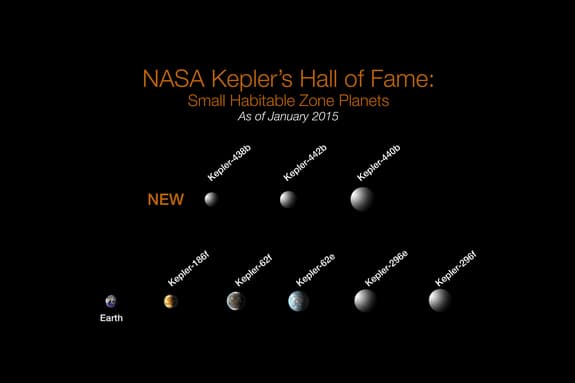
The news worth noting is that scientist have confirmed that out of the recent eight, three planets currently named Kepler-438b, Kepler-440b, Kepler-442b have habitable environment where human life can survive. Of the three found, Kepler-438b and Kepler-442b are made of rock, just like earth thus making them even more suitable for habitation. Additionally, the mission scientists said that the telescope has also found 3,200 more planets and about 90 percent of them should end up being confirmed exoplanets.
The method of confirming a new planet as exoplanet is called transit method which works as follows. The planet under consideration is observed when it crosses its host star. While doing so, Kepler records multiple transits of the planet to confirm its validation as exoplanet. The planets can then easily be confirmed or discarded as exoplanets by analysing data gathered by Kepler or with the use of several space instruments. Some planets might take years to revolve around its star while others which are closer to the host takes less amount of time.
A team member of the Kepler mission, Mrs. Natalie Batalha commented that Kepler was designed for the purpose of finding earth-like planets and they knew that interesting results would definitely come at the end. She also said that this is just the beginning of productive outcomes and there is still a lot of good science left to arrive via Kepler.
Source: <a href="https://www.space.com/28105-nasa-kepler-spacecraft-1000-exoplanets.html" target="_blank" rel="nofollow noopener noreferrer">1,000 Alien Planets! NASA's Kepler Space Telescope Hits Big Milestone | Space</a> | Via: <a href="https://www.utahpeoplespost.com/2015/01/kepler-space-telescope-finds-eight-exoplanets-nasa-marks-milestone/" target="_blank" rel="nofollow noopener noreferrer">Kepler Space Telescope Finds Eight Exoplanets – NASA Marks Milestone • Utah People's Post</a>
The news worth noting is that scientist have confirmed that out of the recent eight, three planets currently named Kepler-438b, Kepler-440b, Kepler-442b have habitable environment where human life can survive. Of the three found, Kepler-438b and Kepler-442b are made of rock, just like earth thus making them even more suitable for habitation. Additionally, the mission scientists said that the telescope has also found 3,200 more planets and about 90 percent of them should end up being confirmed exoplanets.
The method of confirming a new planet as exoplanet is called transit method which works as follows. The planet under consideration is observed when it crosses its host star. While doing so, Kepler records multiple transits of the planet to confirm its validation as exoplanet. The planets can then easily be confirmed or discarded as exoplanets by analysing data gathered by Kepler or with the use of several space instruments. Some planets might take years to revolve around its star while others which are closer to the host takes less amount of time.
A team member of the Kepler mission, Mrs. Natalie Batalha commented that Kepler was designed for the purpose of finding earth-like planets and they knew that interesting results would definitely come at the end. She also said that this is just the beginning of productive outcomes and there is still a lot of good science left to arrive via Kepler.
Source: <a href="https://www.space.com/28105-nasa-kepler-spacecraft-1000-exoplanets.html" target="_blank" rel="nofollow noopener noreferrer">1,000 Alien Planets! NASA's Kepler Space Telescope Hits Big Milestone | Space</a> | Via: <a href="https://www.utahpeoplespost.com/2015/01/kepler-space-telescope-finds-eight-exoplanets-nasa-marks-milestone/" target="_blank" rel="nofollow noopener noreferrer">Kepler Space Telescope Finds Eight Exoplanets – NASA Marks Milestone • Utah People's Post</a>