

MIT Breathes New Life Into Incandescent Light Bulbs To Compete CFLs And LEDs

Massachusetts Institute of Technology and Purdue University have jointly developed an efficient new form of the incandescent light bulb. The research was published in Nature Nanotechnology by three MIT professors namely Marin SoljaÄiÄ, professor of physics; John Joannopoulos, the Francis Wright Davis Professor of physics; and Gang Chen, the Carl Richard Soderberg Professor in Power Engineering, as well as MIT principal research scientist Ivan Celanovic, postdoc Ognjen Ilic, and Purdue physics professor (and MIT alumnus) Peter Bermel.
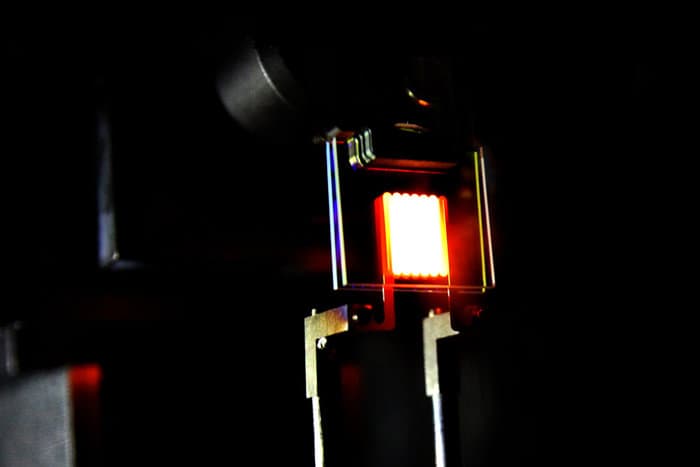
Modified Incandescent Light Source
Thomas Alva Edison invented the incandescent light bulb, and it is till date one of the most influential discoveries ever made. However, as technology developed, shortcomings such as low energy efficiency and higher percentage of non radiative i.e. heat radiation started to become a major concern. Finally, devices with a compact and efficient design, such as fluorescent bulbs (CFLs) and light-emitting diode bulbs (LEDs) replaced it. MIT and the Purdue team have joined hands to resurrect this old light source in a new avatar, with useful modifications and improvisations.
As explained by the team, the process of making the modified lamp comes in two consecutive steps. In the first step, the conventional metal filament is used with its attendant losses. But, instead of allowing the waste heat to dissipate in the form of infrared radiation, a cold-side nanophotonic interference system, surrounding the filament captures this radiation and reflects it back to the filament, and is then re-absorbed and re-emitted as visible light. The nanophotonic structure is made of Earth abundant elements and can be successfully designed using conventional material-deposition technology.
Ilic explained that Nano sized photonic structures played the primary role to successfully operate in a wide range of wavelengths and angles. The crystal is made of thin staked layers and were deposited on a substrate. With its efficient tuning property, the desired visible wavelengths pass right through the material and emerge from the bulb, whereas the infrared wavelengths get reflected, similar to the way a plane mirror acts.
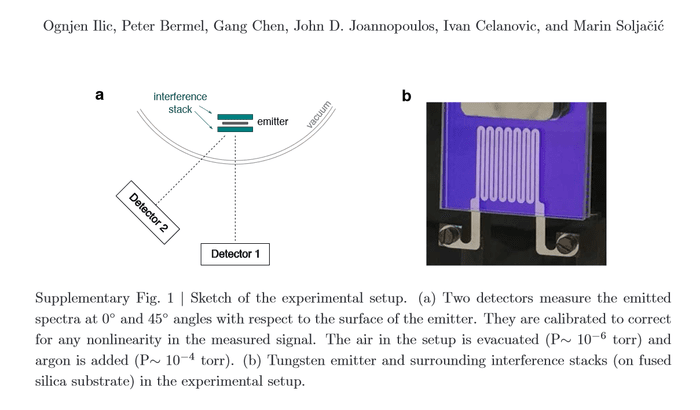
In the next step, scientists targeted the luminous efficiency property of light sources. Traditional incandescent bulbs produce luminous efficiency of 2%-3% , but with the newer modifications the efficiency could rise to as high as 40%. The first run produced 6.6 % efficiency which, is already substantially higher than CFLs and LEDs.
The work was supported by the Army Research Office through the MIT Institute for Soldier Nanotechnologies, and the S3TEC Energy Frontier Research Center funded by the U.S. Department of Energy.

Simulation and experimental measurements over a wide range of wavelengths and angles
Marin SoljaÄiÄ, a member of the research team stated that the new technology also possesses the ability to drastically enhance the performance of energy conversion schemes such as thermo photovoltaics, which converts energy from heat-light-electricty. Although LED's have become very popular nowadays, the researches feel that the new 'nanophotonic' incandescent light bulbs have their own set of advantages, and can become a force to reckon with in the near future.
Source: #-Link-Snipped-# | <a href="https://news.mit.edu/2016/nanophotonic-incandescent-light-bulbs-0111" target="_blank" rel="nofollow noopener noreferrer">A nanophotonic comeback for incandescent bulbs? | MIT News | Massachusetts Institute of Technology</a>