
Laser System Scans Road Accurately Even At 100 kmph

Germans take the roads seriously - and have developed a new high-speed laser scanning technology to survey the roads for evenness & overall quality. Research engineers at Fraunhofer Institute For Physical Measurement Techniques (IPM) in Freiburg have developed a high-speed laser scanner to be approved by the Federal Highway Research Institute for measuring the evenness of the roads in Germany. A single laser scanner can survey a 4 meter wide road effortlessly even at 100 kmph.
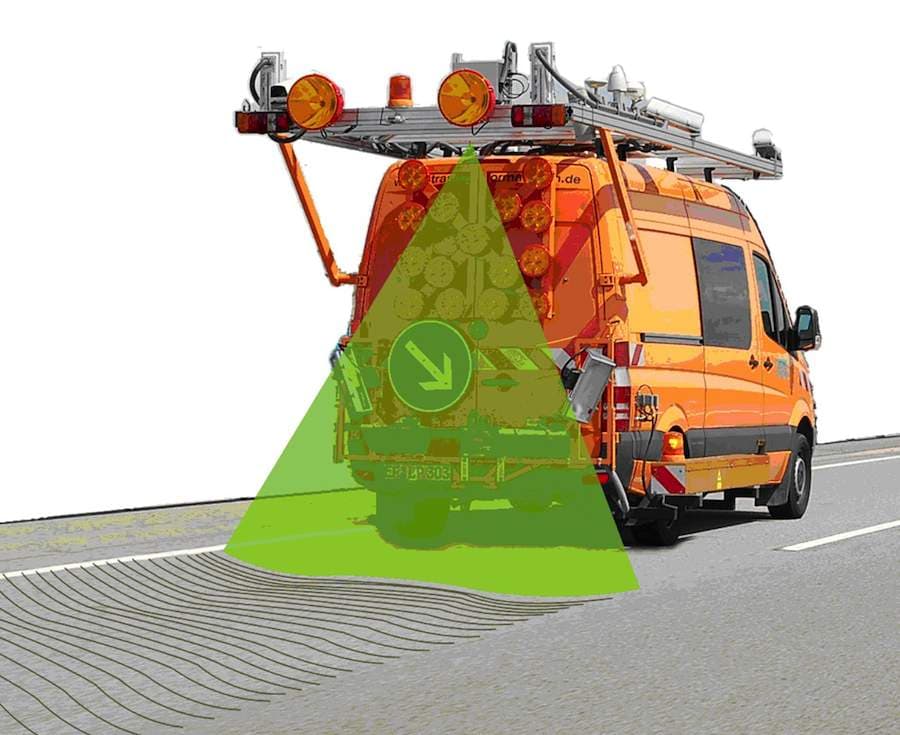
The scanner itself is of the size of a shoebox fixed on the vehicle at about a height of 3 meters. A mirror assembly guides the laser across the width of the road at 90 degrees to the direction of the vehicle. An acquisition angle of 70 degrees is enough to scan th entire width of the road up to 4m wide. The signals that reflect from the asphalt in the road are captured and are fed to a scanner. The scanner then determines the time it took for the signal to return and performs calculations related to the evenness of the road. The accuracy of this machine is impressive - ranging between 0.15-0.30 mm.
The research team says that the external light conditions have no impact on the measurements and the operations can be performed with a vehicle moving at 100 kmph. The machine has already passed the initial field tests. IPM has scanned 15k kilometers of highways and other major roads across Germany.
Source: <a href="https://www.fraunhofer.de/en/press/research-news/2013/april/surveying-roads-at-100-km-per-h.html" target="_blank" rel="noopener noreferrer">Surveying roads at 100 km/h - Research News April 2013 - Topic 4</a>
The scanner itself is of the size of a shoebox fixed on the vehicle at about a height of 3 meters. A mirror assembly guides the laser across the width of the road at 90 degrees to the direction of the vehicle. An acquisition angle of 70 degrees is enough to scan th entire width of the road up to 4m wide. The signals that reflect from the asphalt in the road are captured and are fed to a scanner. The scanner then determines the time it took for the signal to return and performs calculations related to the evenness of the road. The accuracy of this machine is impressive - ranging between 0.15-0.30 mm.
The research team says that the external light conditions have no impact on the measurements and the operations can be performed with a vehicle moving at 100 kmph. The machine has already passed the initial field tests. IPM has scanned 15k kilometers of highways and other major roads across Germany.
Source: <a href="https://www.fraunhofer.de/en/press/research-news/2013/april/surveying-roads-at-100-km-per-h.html" target="_blank" rel="noopener noreferrer">Surveying roads at 100 km/h - Research News April 2013 - Topic 4</a>
0