

Laser Microscope Can See 10nm Objects!

@thebigk
•
Oct 24, 2024
Oct 24, 2024
3.2K
Laser illuminated microscope now allows researchers to see objects that are only 10nm wide. The super-resolution optical microscope does not require fluorescent dyes and it's being claimed that this advancement offers a practical tool for biomedical and nano-tech research. It's interesting to note that the conventional microscopes can resolve objects no smaller than 300 nm. The restriction is known as the 'diffraction limit' - aka half the width of the wavelength of light that is being used to view the specimen.
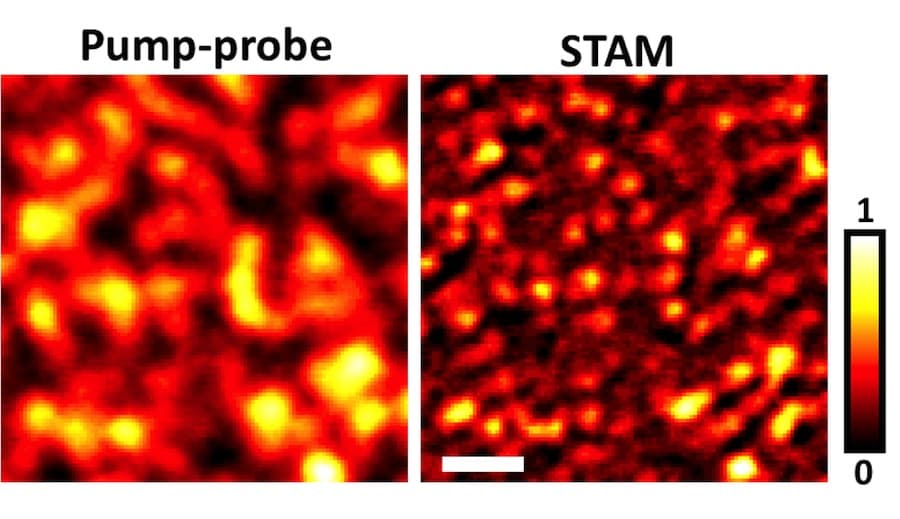
The system excites the atoms of the illuminated molecules to higher energy states while the others are at the ground state. The contrast between excited & ground state levels is compared to produce the required images.
Read more about this research on the official webpage of Purdue University - <a href="https://www.purdue.edu/newsroom/releases/2013/Q2/super-resolution-microscope-possible-for-nanostructures.html" target="_blank" rel="noopener noreferrer">'Super-resolution' microscope possible for nanostructures - Purdue University</a>
Image Credit: Weldon School of Biomedical Engineering, Purdue University
This 'diffraction limit' put restrictions on observations of molecules like proteins & lipids as well as nanotubes. But the latest advancement allows optical imaging of non-fluorescent specimen. The official name of the imaging system is 'STAM' aka Saturated Transient Absorption Microscopy. The system combines three laser beams to illuminate the objects to be studied. The system excites the atoms of the illuminated molecules to higher energy states while the others are at the ground state. The contrast between excited & ground state levels is compared to produce the required images.
Read more about this research on the official webpage of Purdue University - <a href="https://www.purdue.edu/newsroom/releases/2013/Q2/super-resolution-microscope-possible-for-nanostructures.html" target="_blank" rel="noopener noreferrer">'Super-resolution' microscope possible for nanostructures - Purdue University</a>