

Hacked Bluetooth Hearing Aids Lets You Listen Wi-Fi Signals

@satya-swaroop-YDeBJM
•
Oct 24, 2024
Oct 24, 2024
1.4K
Frank Swain, a science writer and sound artist Daniel Jones have made it possible for people to listen Wi-Fi signals. They have managed to hack Bluetooth hearing aids to monitor ambient Wi-Fi signals being transmitted by routers. The project was conceptualised by Frank Swain when he had to wear a pair of Starkey Halo Bluetooth hearing aids to compensate for his hearing loss. Being a writer for many science news websites he decided to upgrade the capability of his hearing aids that can surpass normal human hearing capabilities and turn his disability into superability.

His modified Bluetooth hearing aids generate sounds from Wi-Fi signals in the following manner. First there is a crackling noise in the background which increases or decreases depending upon the density of Wi-Fi networks in the area. Another clicking sound, similar to the one you hear on a Geiger counter lets you know how closer you are to a Wi-Fi source. This clicking sound is calibrated for stereo effect. This means if a network is located to your right you hear it on your right ear and if the network is on your left the sound is heard on the left ear piece. On the foreground you get to hear a weird and faint melody that is generated by translating the network ID. Sound artist Daniel Jones has programmed the device to translate each letter and number into a different note. You can listen to the soundtrack produced during a walk across BBC Broadcasting House on <a href="https://soundcloud.com/ideoforms/phantom-terrains-broadcasting-house" target="_blank" rel="nofollow noopener noreferrer">Stream Phantom Terrains data walk: BBC Broadcasting House by ideoforms | Listen online for free on SoundCloud</a>.
The project “<a href="https://phantomterrains.com/" target="_blank" rel="nofollow noopener noreferrer">Phantom Terrains</a>†took six months to build and is currently in the prototype stage. The team obtained funding from UK’s Nesta (National Endowment for Science, Technology and the Arts).The team took the data they collected from their walk at the BBC office and drew them in the picture below.
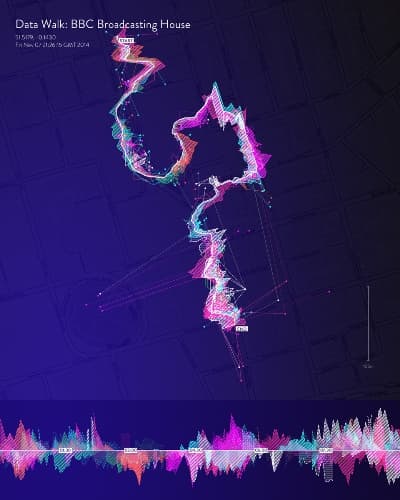
The stronger signals are plotted as wider shapes; the colour denotes the router’s broadcast channels and the fill patterns signify the network’s security. The team’s objective is to build an additional sense that helps us monitor the ever increasing ambient data signals. So is this new sense something you look forward to? Let us know in the comment section below.
Source: #-Link-Snipped-#
His modified Bluetooth hearing aids generate sounds from Wi-Fi signals in the following manner. First there is a crackling noise in the background which increases or decreases depending upon the density of Wi-Fi networks in the area. Another clicking sound, similar to the one you hear on a Geiger counter lets you know how closer you are to a Wi-Fi source. This clicking sound is calibrated for stereo effect. This means if a network is located to your right you hear it on your right ear and if the network is on your left the sound is heard on the left ear piece. On the foreground you get to hear a weird and faint melody that is generated by translating the network ID. Sound artist Daniel Jones has programmed the device to translate each letter and number into a different note. You can listen to the soundtrack produced during a walk across BBC Broadcasting House on <a href="https://soundcloud.com/ideoforms/phantom-terrains-broadcasting-house" target="_blank" rel="nofollow noopener noreferrer">Stream Phantom Terrains data walk: BBC Broadcasting House by ideoforms | Listen online for free on SoundCloud</a>.
The project “<a href="https://phantomterrains.com/" target="_blank" rel="nofollow noopener noreferrer">Phantom Terrains</a>†took six months to build and is currently in the prototype stage. The team obtained funding from UK’s Nesta (National Endowment for Science, Technology and the Arts).The team took the data they collected from their walk at the BBC office and drew them in the picture below.
The stronger signals are plotted as wider shapes; the colour denotes the router’s broadcast channels and the fill patterns signify the network’s security. The team’s objective is to build an additional sense that helps us monitor the ever increasing ambient data signals. So is this new sense something you look forward to? Let us know in the comment section below.
Source: #-Link-Snipped-#