

ESA's Gaia Spacecraft Discovers Its First Supernova- Gaia14aaa

European Space Agency (ESA) had deployed an unmanned space observatory, Gaia, in July for constructing a precise three-dimensional space catalog of about 1 billion astronomical objects, predominantly stars. For this purpose, Gaia started its work of repeatedly scanning the sky from July 25. Less than two months after its deployment, the spacecraft discovered its first âsupernovaâ in a distant galaxy. A supernova is said to be a catastrophic explosion that briefly outshines a galaxy by radiating energy.
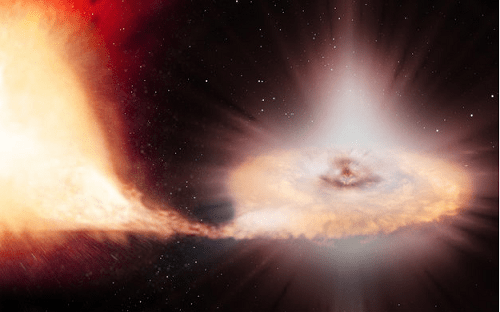
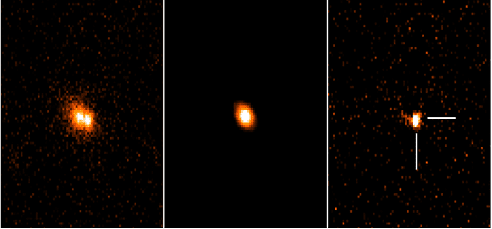
The stellar explosion discovered by Gaia is now named as Gaia14aaa. It occurred in a faraway galaxy, about 500 million light-years away. The supernova was named on August 30 when the astronomers were sure about the sudden rise in the galaxyâs brightness after studying the collected data. According to the ESA, this anomalous spike of light took place between the two observations made, a month apart, by the spacecraft. The team also observed that the location of the glaring spot of light, in Gaia14aaa, was slightly out of line from the core of the galaxy. This examination suggested that the explosion is not related to a central black hole. The researchers further searched for more details in the light of this new source to back up their claim. They searched for the presence of various chemical elements in the source of the light emitted by the galaxy.
Gaia not only records the position and brightness of stars and galaxies but also splits their light in order to create a spectrum. A low-resolution spectrum is produced by using two prisms that spans red and blue wavelength. This spectrum allows the astronomers to find the chemical components in the source of the light.
Gaiaâs main objective is to monitor approximately one billion stars in the final catalogue for next five years. The spacecraft will examine the target stars about 70 times during this period. Dr Hodgkin, a member of Gaiaâs Science Alert Team, mentioned in a statement that Gaia scrutinizes each patch of the sky over and over so that it can place thousands of âguest starsâ on the celestial tapestry which will help to spot the powerful events in the Universe, like supernova.
Source: #-Link-Snipped-#
