
Bristol University Researchers Create 3D Objects That Can Be Felt In Mid-Air

@chaitanya-kukde-yk3G31
•
Oct 23, 2024
Oct 23, 2024
1.3K
Researchers at Bristol University, UK have developed a method to 'feel' virtual shapes using ultrasound. The technology, called 'haptics' is being used in a wide array of applications ranging from entertainment to surgical training and rehabilitation. The researchers published their result in the latest issue of ACM Transactions on Graphics and the same will be presented at the SIGGRAPH Asia 2014 conference. The research team includes Dr Ben Long and colleagues Professor Sriram Subramanian, Sue Ann Seah and Tom Carter from the University of Bristol’s Department of Computer Science.
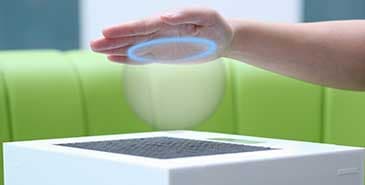
The new technology could enable surgeons to explore a CT scan by enabling them to feel a disease, such as a tumour. The sensation of touch is induced using ultrasound waves. By using complex patterns of these waves, air disturbances are created, which allow us to feel virtual three dimensional shapes. The researchers visually demonstrated the ultrasound patterns by imposing them on a thin layer of oil. This produced depressions on the surface of oil in the same manner as spots lit up by a lamp.
The system under experimentation also produces 3D shapes which when viewed through a 3D displays can entirely create a virtual object which can be touched and felt. As stated by Dr. Ben Long, this technology when combined with immersive virtual reality, could be used in a wide variety of applications.
Pranav Mistry, Oculus Rift, you guys listening?
Source: <a href="https://bristol.ac.uk/news/2014/december/haptic-shapes-using-ultrasound.html" target="_blank" rel="nofollow noopener noreferrer">December: Haptic shapes using ultrasound | News and features | University of Bristol</a>
The new technology could enable surgeons to explore a CT scan by enabling them to feel a disease, such as a tumour. The sensation of touch is induced using ultrasound waves. By using complex patterns of these waves, air disturbances are created, which allow us to feel virtual three dimensional shapes. The researchers visually demonstrated the ultrasound patterns by imposing them on a thin layer of oil. This produced depressions on the surface of oil in the same manner as spots lit up by a lamp.
The system under experimentation also produces 3D shapes which when viewed through a 3D displays can entirely create a virtual object which can be touched and felt. As stated by Dr. Ben Long, this technology when combined with immersive virtual reality, could be used in a wide variety of applications.
Pranav Mistry, Oculus Rift, you guys listening?
Source: <a href="https://bristol.ac.uk/news/2014/december/haptic-shapes-using-ultrasound.html" target="_blank" rel="nofollow noopener noreferrer">December: Haptic shapes using ultrasound | News and features | University of Bristol</a>