
Researchers Observe Previously Unknown State Of Water Molecule

Severe confinement of water by artificial means results in a completely different state that does not match with either of the well known fundamental physical states, namely solid, liquid, gases or plasma. Physicists from the Oak Ridge National laboratory have processed water via neutron scattering and computationally modeled the output which indeed displays a peculiar behaviour of water, that has never been studied before.
Researchers confirmed that their method has pushed them to discover a “quantum tunneling state†of water molecules where the water is already restricted inside a 5 angstrom diameter mineral beryl. Team leader, Lexander Kolesnikov of ORNL's Chemical and Engineering Materials Division explained that the constricted water produces quantum motion in segregated potential walls. Unlike classical predictions, the oxygen-hydrogen combination being delocalized, transports itself from one place to another place in no time.
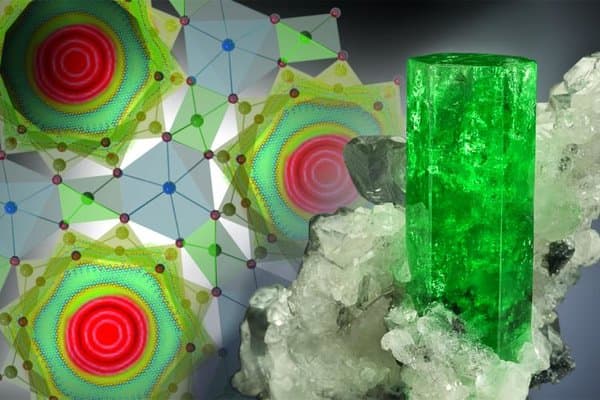
Water In Beryl
Practically, the combined molecules simultaneously distribute their presence into six equivalent positions. The collected information from simulations and experiments will lead the researchers to understand the core of thermodynamic properties and its corresponding behaviour in tight environments. Lawrence Anovitz, co-author of the report admitted that understanding the behaviour in the quantum world would culminate into a massive success, arising from seemingly different research fields.
Anovitz further added that this particular research adds bears value, because it has been a unique way to observe how water exactly uses energy. Excitingly, the way the molecules had chosen their paths is the same as what actually runs inside an elegant emerald ring lying on anyone’s hand. Kolesnikov explained that the experimental results significantly equates the average kinetic energy of the water protons to measure their quantum motions.
Researcher Narayani Chowdhury from the Lake Washington Institute of Technology has shown that the tunneling behavior is connected by means of action to the vibrational dynamics of the confined beryl structure. The research is funded by DOE's Office of Basic Energy Sciences and the complete report regarding this work is published in the Physics Review Letters journal.
Source: <a href="https://www.ornl.gov/news/ornl-researchers-discover-new-state-water-molecule" target="_blank" rel="nofollow noopener noreferrer">ORNL researchers discover new state of water molecule | ORNL</a>
Researchers confirmed that their method has pushed them to discover a “quantum tunneling state†of water molecules where the water is already restricted inside a 5 angstrom diameter mineral beryl. Team leader, Lexander Kolesnikov of ORNL's Chemical and Engineering Materials Division explained that the constricted water produces quantum motion in segregated potential walls. Unlike classical predictions, the oxygen-hydrogen combination being delocalized, transports itself from one place to another place in no time.
Water In Beryl
Anovitz further added that this particular research adds bears value, because it has been a unique way to observe how water exactly uses energy. Excitingly, the way the molecules had chosen their paths is the same as what actually runs inside an elegant emerald ring lying on anyone’s hand. Kolesnikov explained that the experimental results significantly equates the average kinetic energy of the water protons to measure their quantum motions.
Researcher Narayani Chowdhury from the Lake Washington Institute of Technology has shown that the tunneling behavior is connected by means of action to the vibrational dynamics of the confined beryl structure. The research is funded by DOE's Office of Basic Energy Sciences and the complete report regarding this work is published in the Physics Review Letters journal.
Source: <a href="https://www.ornl.gov/news/ornl-researchers-discover-new-state-water-molecule" target="_blank" rel="nofollow noopener noreferrer">ORNL researchers discover new state of water molecule | ORNL</a>
0