

Low-Cost Squishy Material For Robots Developed By MIT

@chaitanya-kukde-yk3G31
•
Oct 22, 2024
Oct 22, 2024
1.8K
If the title makes you remember T-1000, the antagonist of the sci-fi movie Terminator 2: Judgement Day, you aren't alone. Made of liquid, T-1000 was able to squeeze itself into tight spaces and could repair itself when harmed. MIT et al have managed to create something in the similar vein, but much less evil than the T-1000. Low cost material, made of wax and foam which can change states from soft to hard and vice-versa have indeed become a reality. These materials will be primarily used for building 'squishy' robots which will be malleable enough to navigate through tiny spaces but will also regain their rigidity as and when required.
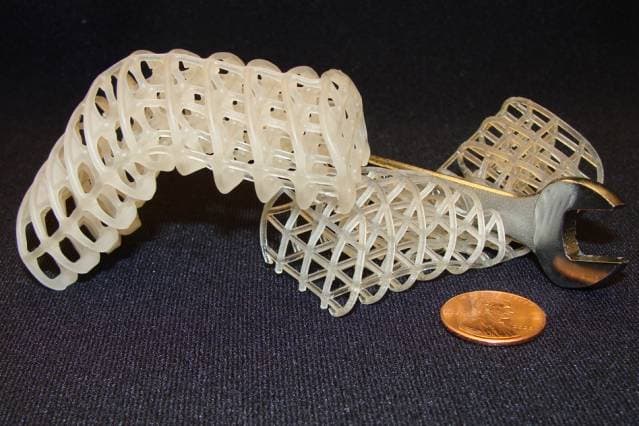
The research team consisted of members from MIT, Max Planck Institute for Dynamics and Self-Organization and Stony Brook University. A paper reflecting their experiments with the newly fabricated material was presented in the Macromolecular Materials and Engineering journal. The Chemical Robot program US DARPA provided the starting point for the development of this material. The movement dynamics of molluscs (such as octopus) also proved to be an inspiration for the development.
The material is actually a foam structure covered in wax. Foam was chosen for its ability to be squeezed into a fraction of its original size. Polyurethane foam was dipped into a bath of hot wax. A wire ran around the structure which carried a current in order to melt the desired portion of the structure. Thus, melting a specific portion makes the structure move in a particular way. A movement in almost any direction can be achieved using this technique.
After experimenting with polyurethane researchers used a 3-D printed lattice-structured material for further analysis. This allowed them to carefully control the position of each of the compressive microstructure. One of the scientists said that wax could be replaced by a stronger material, such as solder, in case of an appropriate application.
The robots made from such materials could be used in an assortment of applications such as robot-assisted surgery, search-and-rescue operations, equipment cleaning and maintenance, etc. Can you think of any other applications where these robots can be put to use? Share with us in the comments.
Source: #-Link-Snipped-#
The material is actually a foam structure covered in wax. Foam was chosen for its ability to be squeezed into a fraction of its original size. Polyurethane foam was dipped into a bath of hot wax. A wire ran around the structure which carried a current in order to melt the desired portion of the structure. Thus, melting a specific portion makes the structure move in a particular way. A movement in almost any direction can be achieved using this technique.
The robots made from such materials could be used in an assortment of applications such as robot-assisted surgery, search-and-rescue operations, equipment cleaning and maintenance, etc. Can you think of any other applications where these robots can be put to use? Share with us in the comments.
Source: #-Link-Snipped-#